Friday, 13 November 2015

Needlefelting a Christmas Tree Bauble

"Is that all you've done, the whole afternoon?"
"Lovely, isn't it?"
"Mmm.  How we shall enjoy seeing the tree decorated - for Christmas 2016."
Needlefelting is thoroughly therapeutic.  Some people do those adult colouring in books to chill out.  I was feeling perfectly tranquil after a couple of hours stabbing away at one felted wool ball, til my companion, Elinor Gotland, pointed out the flaw in my master plan for a retail sales empire.  It had taken a fair amount of time just to experiment with different kinds of fleece for making the initial felted balls.  The Easy DIY Drier Balls instructions are indeed easy, but the results vary according to the fibre.  I am now able to advise you that if you knot
a handful of fine merino or alpaca into the end of a pair of tights and put it through the hottest cycle on your washing machine, the ball will be almost impossible to cut loose.  Do the same with a handful of Black Welsh Mountain sheep's fleece and it will felt into a soft ball, bearing a happy resemblance to plum pudding. Try wrapping silk fibres round a core of wool and they barely felt at all.  
Recalling the dense felting tendency of a mixed batt of fleece I got ages ago, I thought I would try felting lumps of that. The washing machine produced good, solid wool balls, nice and rustic.
"Look, Elinor.  With a loop of linen thread to hang them from, these are a pleasure to needlefelt into Christmas decorations."
"Best you share the joy, Beaut."
Which seemed a good idea.

If you bought one of these felted balls as part of a Christmas Kit at Crafts by the Sea, here is how I needlefelted the prototype.  First off, the felting needle is barbed and very sharp.  Go slowly til you get the knack of keeping your fingers out of the way.  If you get really keen and want to buy more felting needles, I got these from Adelaide Walker.


The yarn is handspun, two ply, which means you can pull it apart into two separate threads, called singles.  While any yarn can be needlefelted, handspun singles are much easier to fix on than many millspun yarns.  Lay the end of a single across the felted ball and jab it a few times.  This pushes some of the fibres into the ball and starts to felt it on.  Curve the single around the ball in deep bends, ending up by felting it back
over your starting point.  Now use short lengths to add curved side branches at about six points. Don't worry if it looks like a dog's dinner, the trick with needle felting is to persevere.  If you really hate the look of something you've done, it is easy to pull it back off. The coloured fluff is called wool tops.  The fibres are all aligned and the best way to take out a little portion, is to pull just the tips of the fibres at one end.  Use the felting needle to stab in some red
fibres to the end of one of your side branches on the felted ball. Swirl the wool in a circle and needle it in.  You can leave it quite fluffy and textural or jab it on firmly with lots of stabs.  Now choose a smaller amount of another colour to fill in the centre.  Use the dark yarn single to outline the flower, then add a couple of inner lines.  I like to think mine were Charles Rennie Mackintosh roses.
 A flower for every stem and a pair of leaves for every flower, not a problem if they overlap, add more if you fancy or do fewer.  Enjoy.

After Christmas, the ball could become a pincushion or sharp ear ring stems could be poked into it to keep them safe.  One thing, it definitely won't get broken.

Friday, 6 November 2015

Making a Picture from an Oak Leaf Contact Print

Having failed to get leaf prints from dry oak leaves so far this autumn, I picked up some more colourful, leathery, freshly fallen ones and had another go at repeating the contact dye process.   Being short on good silk and optimism, I used a section of cheap tubular noil silk jersey that has been in the back of the cupboard because it still smells faintly of cerecin.
This time the leaves printed really well.  I laid the cloth out damp to admire.
"That's a muddy old colour."  My companion, Elinor Gotland, wrinkled her nose and stepped back.  "Ych y fi, Beaut!  Planning to wear it out on a date with a fishmonger?"  
Just to head off another diatribe on the foolishness of buying anything but pure habotai silk, I jumped in fast.
"That smell will fade once it's dried out. Actually, Elinor, I think the fuzziness of noil jersey has a more autumnal effect than a fine silk print.  The whole thing almost looks like a tree to me."  
Following which thought, I made a frame out of old copper piping with shiny new right angle bends and stretched the tubular silk jersey over it, backed with an old wool blanket.
"Look, Elinor, I've sewed a dry oak 
gall on down the bottom and made it into a picture."
"Take my advice, Beaut, leave art to the artists."
"Joseph Beuys said everyone is an artist."
"Mmm, well, Andrew Graham-Dixon said not everyone should exhibit.  Anyway, contact dye prints come down to chance, they aren't artistic expression." 
"Now I've needlefelted on a gall wasp.  I wonder what that could possibly represent?"
Gall wasps are really almost too small to see as they hover under the oak trees.  They don't sting and their tiny nasal song is somehow soothing, not annoying, like a gnat's. Standing in the woods, I was wondering what they could be saying to each other, but looking on the web, all I found was the explanation that bigger insects flap their wings more slowly giving a lower pitched buzz, so presumably, the gall wasp's particular sound is just a function of very tiny wings beating fast.

Talking with gall wasps remains impossible for me, though through the logic of an interweb search, I did find an article on what insects perceive as they fly. When I saw the flight diagram, I didn't need to read what this behaviour signified, the pattern communicated enough. So here's my picture, it's called Language 1:  Gall Wasp.
"All about sex, is it, Beaut?"
"Romance, actually, Elinor."
"You'll be doing tragedy next, I expect. How about Lady Macmoth? 'Out, out, brief candle!'"

Friday, 30 October 2015

Knit the Sky Book Review and the Clock Back Flap Bag Project

"Look, Elinor, I could spin the sky!" Pulling out a pillow case full of sheep's fleece used to exhaust the Japanese Indigo dye vats, I tossed armfuls of blue wool towards my companion. "It's so exciting, Storey Publishing have sent me another book to review.  Listen to the title, 'Knit the Sky, Cultivate Your Creativity with a Playful Way of Knitting.'"  Elinor was disappearing under a rain of falling fleece.  "The actual sky project says, 'Each day, you will knit a stripe in colors that match that particular day's sky... At the end of a year, you will have a scarf that the clouds have drifted through.'"  

I clasped the book to my heart,  "Totally awesome idea, from now on, we absolutely must take time to 'appreciate the colorful show that swirls above our heads at every moment.'"  Flinging myself down on the bed, I gazed up through the skylight. 
Elinor dug her way up from under the drift of wool.  
"Bloody hell, Fran, you're as playful as a heffalump, overdosed on honey."  
"Oh, don't be mouldy.  I'd love to spin and knit a sky scarf."


My companion lay back beside me and polished her specs.  Solid cloud could just about be seen through the seagull shit caking the glass.
"Just a couple of snags, Beaut. We live in Wales, winter is coming and you're going to need more cloud greys than sky blues." She took the book away from me and turned the page.  "Don't forget that fleece came off a Welsh Mountain crossbreed sheep. Spin it and you can knit a scarf that will exfoliate your neck every time you 'let your beautiful garment remind you to keep looking up.'"  Rolling off the bed, Elinor started fossicking about in my yarn stash.
"These are all quite soft." she called.  "How about knitting a turdily awesome scarf, one that would remind you to keep looking down?"
"A what?"  I sat up to see she had chosen a selection of my hand spun woollen yarns.
"Knit the Shit.  A record of your bowel habit with a stripe for every poo.  'With each flush, the colours of an unrepeatable crap disappear down the pan...'"
I grabbed the book back out of her hooves.  
"Stop laughing, Elinor, that's really horrible."
"Then you could use all your piss awful plant dyed skeins to decorate it with, oh yes ... tiddly pom poms."

It is no use trying to have a sensible conversation with an hysterical sheep.  Knit the Sky was written by Lea Redmond.  Though I'll grant she can come across a little saccharine for the tooth of your typical Brit, I do think she is onto something good with her philosophy of actively infusing your knitting with your own life. Lea is right, I'd bet most knitters find an old jumper will remind them of the phase of time when they had it on the needles, how they were feeling, who they were with.  Even working from a standard pattern, the act of creation makes a handknit into a deeply personal microcosm.  Why not go another step and let the changing world around you influence the colours or dictate the shapes? 
The thirty projects in the book may be simple to knit, but there are considerable challenges in carrying them out.  The idea of knitting as a mode of connection with people and places leads Lea to suggest partnerships and family group projects or talking to all the people in your street before knitting a stripe the colour of their houses. In my case, that would mean a hundred shades of pebble dash and a monstrous strain on my British reserve.  Last Saturday afternoon, I was sitting in the kitchen, still leafing through the book.
"I quite fancy knitting an 'Heirloom Time Traveller'.  You do half a scarf and put it away with a message to your great-grandchild, for them to finish in a hundred years time."
Elinor made a face and set her teacup down.
"They don't have moths in America, then, Beaut?"
"Lea has that covered, cedar wood repels insects.  She says 'Imagine that you stumble across a cedar box in your grandparent's attic."
"Your grandchild would need a bloody good imagination, there's been no attic in this house since you had the loft converted."
"Oh, picky, picky, you're not supposed to take it so literally.  Since my family don't live in the Little House on the Prairie, how about a 'Sun Salutation'?  Great excuse to spend the whole day knitting from sunrise to sunset."
"Another scarf, is it?"  Elinor read over my shoulder.  "'A circle shape, knit using the intarsia technique will quickly grow on the wooden horizon of my needles, mimicking the sunrise in real time.'  Intarsia?  You can barely switch the kettle on before 9am."
"Enough, Elinor, I am going to have a go at this one.  The clocks go back an hour for the end of British Summer Time tonight, so I'll have an extra hour in bed."
"Hate to break this to you, Beaut, but I think you'll find the sun sticks to Greenwich Mean Time."

The Clock Back Flap Bag Project


On Saturday evening, I knitted a circle in white wool, bound off in black i-cord and crocheted clock hands pointing to 1 o'clock. Just as well I did this bit in advance, as it took ages longer than I thought and I really am slow in the morning.  
Getting up at 6.45am on Sunday, oh bother, it was already light, though the actual sunrise didn't happen til 6.55am.  In short, I did not cast on my 25 stitches before the crack of dawn and completely forgot to bow, needles in hand, to 'greet the centre of our solar system with all the attention I can muster.'  It was beautiful morning, nonetheless.  Using a couple of balls of chunky Sirdar colour change yarn that my sister
bought at a car boot sale, I was knitting in an extra strand of white Shetland yarn while the sun shone and a strand of grey Herdwick when it got cloudy.  Himself appeared at 9am to tell me he thought this project had bonkers written all over it.  Still, the cup of tea and bacon sandwich were most welcome.  With the feeling restored to my frozen hands, I cast on 3 more stitches at each end of the row to start the body of
the bag.  Elinor did not arise til 11.30am, by which point I had had a hot shower and walked the dog and was getting along much faster.
"I'll say this for you, Beaut.  You've got a whim of iron."
Minding the shop Crafts by the Sea that afternoon, an occasional customer interrupted the flow of knitting, himself stopped by on his cycling route and BG brought cups of tea when she joined me  
for an hour or two.  While these events are not marked within the bag, I knitted a strand of white yarn with two shades of blue, since the sun shone steadily through the condensation on the shop window.  Bands of dark cloud later on meant frequent changes to grey and lots of little ends to weave in later, before a grandstand view of the sun setting over the sea about 5pm.  Time to shut up the shop and cast off.  Back home, the pieces of knitting went through a 40 degree cotton wash machine cycle.  I wondered if the various millspun yarns would shrink differently, giving fancy effects, but they were all 50% wool and the final result was firm and even.  I went to bed leaving it pinned out flat on a towel to dry.

Final verdict - Knit the Sky is a book worth reading.  Lea Redmond inspired me to knit in a way I have never done before, integrating process and product, making an ordinary day memorable and commemorated in knitting.


Published October 2015
ISBN 978-1-61212-333-2 hardcover at £14.99
ISBN 978-1-61212-334-9 ebook

Take no notice of that awful sheep.

Friday, 23 October 2015

Failing to get a Contact Dye Oak Leaf Print

"One of those weeks, isn't it, Beaut?"  Elinor Gotland may be a hard-hitting ewe, but even a stone would be moved to sympathy by the sight of my mangled knitting.
"That bloody puppy!  It's not just the wool and the work, she's chewed up the cord on my circular needle."
"I'd put that collar back on her."
Oh.  For reasons unfathomable to me, Yarrow went into a deep decline when obliged to wear a collar.  Not naughty, just miserable, for several days she had to be towed around on her lead or she would just lay down.
"All that rolling around whimpering and scratching at her neck, she only did that when you were looking."
"She's not an actress, Elinor.  I think the collar just made her very unhappy."  
My companion passed me a cup of tea and shoved the ashtray across.
"I don't know who's the bigger fool, you or that dog."


It was true enough, things have not been going to plan lately.  The falling leaves reminded me that last autumn, I got some nice oak leaf prints on silk and cotton, simply by rolling the fabric covered in leaves round a piece of plastic drainpipe and simmering it in leftover plant dye baths.  During my abortive attempts to walk the dog, I had been picking up fallen oak leaves and following the same procedure when we got home.
There were two plant dye afterbaths sitting on the patio, one still with a bag of dyers chamomile flowers in it and one made from yarrow and Achillea Coronation Gold, which contained a fair amount of iron as well as the blackened plant remains.  I soaked the string in iron water before tying the bundle for the chamomile dye bath and just put the other bundle straight
into the iron rich pot.  They looked much the same while drying out for a day or two.  I unwrapped them, curious to see if more iron made better prints only to find the oak leaves had hardly made any mark at all.  Last year, there were clear outlines and brown colours from the back of the leaves.  This time, if I hadn't included some dessicated stalks of coreopsis, which it turns out still make good orange prints even at the very far
end of their season, the scarves would have turned out utterly dull.
With the little dog's collar off, joyful racing about on walks resumed, though no obedient returning to my call.  Last month, training was going so well.  I am doing things wrong, but can't work out exactly what.  During a pause to catch my breath, curse my ignorance and folly and of course, the vagaries of an unkind world, I sat down on the deep red, prickly leaves of low growing brambles. 
Picking out the barbs, it occurred to me to try a contact dye with them in the same dye bath, maybe find out if the problem lay in the oak leaves or the dyebaths. In case it was insufficient iron, I rolled some rusty nails and washers into the bundle and as insurance, I added in sprigs of fresh coreopsis.  The plants had just been knocked flat by my lovely canine assistant, during another disagreement about who was allowed to dig the
garden and where.  Much better leaf prints appeared on the outer layer of silk, not so good on the deeper layers, despite dark stains of iron around the nails. 
Elinor and I sat on the patio, looking at the washed and ironed scarves hung out for display on the washing line.  We drank our tea and lit up.
"I think possibly those oak leaves I picked up were too dried out. Could try dyeing with some that have a bit of life and leatheriness left in them.  See what happens."
"Reasons to be cheerful, Beaut.  It isn't raining, your silk wasn't totally wasted and at least that dog is keeping you fit."


Friday, 16 October 2015

Shopping for German Wool Yarn in Berlin


"No sheep in Germany?"  Elinor nearly choked on her cappuchino.
"That's what the lady in the wool shop said."  I was thoroughly disheartened.  Before BG and I left for our epic adventure in Berlin, a kind friend had given me a link to Knitmap.  Resorting to old school technology, I now had wool shop addresses written down on a piece of paper and had been hoping to bring home some authentic German wool yarn.
Our old friend and star sheep of the international stage and screen, had arranged to meet us in what seemed to be the only courtyard left in Hackescher Markt not yet subsumed by tourist bijouterie.  Once she had coughed up the last drop of her frothy coffee, she patted me on the arm.
"Well, Beaut, I can name at least one ewe living right here in Berlin.  Back in our cabaret days, she was an artful hoofer, notoriously elusive, but maybe I can hunt her down." Wrapping a scarf around her head and slipping on some enormous shades, Elinor assumed the air of a sheep of mystery.  As BG and I took a walk to Museum Insel, we caught just a glimpse of her entering the stagedoor of the Chamaleon.
Our party convened once more at a truly civilised venue, handmade Berlin, a wool shop with its own cafe on Monpijou Platz.  They have handmade knitwear and a range of luxury yarns from all round Europe, including some highly desirable skeins from an indie dyer in Berlin, but not a sniff of real German wool.  BG went to have a nose through the fancy stuff while I quizzed Elinor.
"So, any luck?"
"Ah, Foxy was always a fugitive soul." Hauling on the string dangling from her glass mug, Elinor sighed.  "Could you nip in and get me some milk?  Berlin has the best food in the world, but they do have funny ideas about tea." After much faffing about with a hot teabag, she continued.  "I did hear Foxy's been running a beach bar in Kreuzberg."
"A beach bar?  Aren't we miles from the coast?"
"Oh, in Berlin you just dump a load of sand on a bit of empty ground along the riverside, put up a couple of deckchairs and people will soon be dancing the tango."
And so that very afternoon we went pounding the streets of Kreuzberg, sustained only by cheesecake and heavenly felafel from the Turkish Market.  Careful inspection confirmed this was a great spot for buying fruit, veg, fabric and bricabrac, but not wool and what is more, the beach bars closed down in September.  Despite developing a Pavlovian panic response to the whirr of bicycle wheels, BG and I arrived safely at Faden Insel on Oranienstrasse, a proper knitters' wool shop crammed with yarn.
Asked for German sheepswool yarn, the lady immediately reached over to a box at the back of the shop, explaining that though there are no woollen mills in Germany, this yarn was spun in Switzerland from a mix of linen and the fleece of Schwabische sheep from the Jura in Southern Germany.  Ausgezeichnet!
With our key wool objective attained, next day, we planned to appreciate art at the Deutsches Guggenheim Museum.  Elinor had other ideas.
"If you want a European cultural experience, Beaut, just go and drink coffee in West Berlin."  She wasn't wrong.  Rattling above the Tiergarten on the S-Bahn to Bahnhof Zoo, the onset of cold weather had turned the trees all gold and orange.  In the quiet, stately avenues, there were cushions and blankets on the
seats outside the cafes. BG disturbed the dust and the orderly hush in the second hand bookshops, I loved the cheerful bustle of La Laine wool shop, which stocked a huge range of Lang brand yarns, though no German sheep's wool.  The staff could not have been kinder, BG spent ages in the changing room choosing a top and grabbed a glorious bargain, end of range, colour change skein. One of us was very taken with a yarn named Berlin, but my energy was running low.
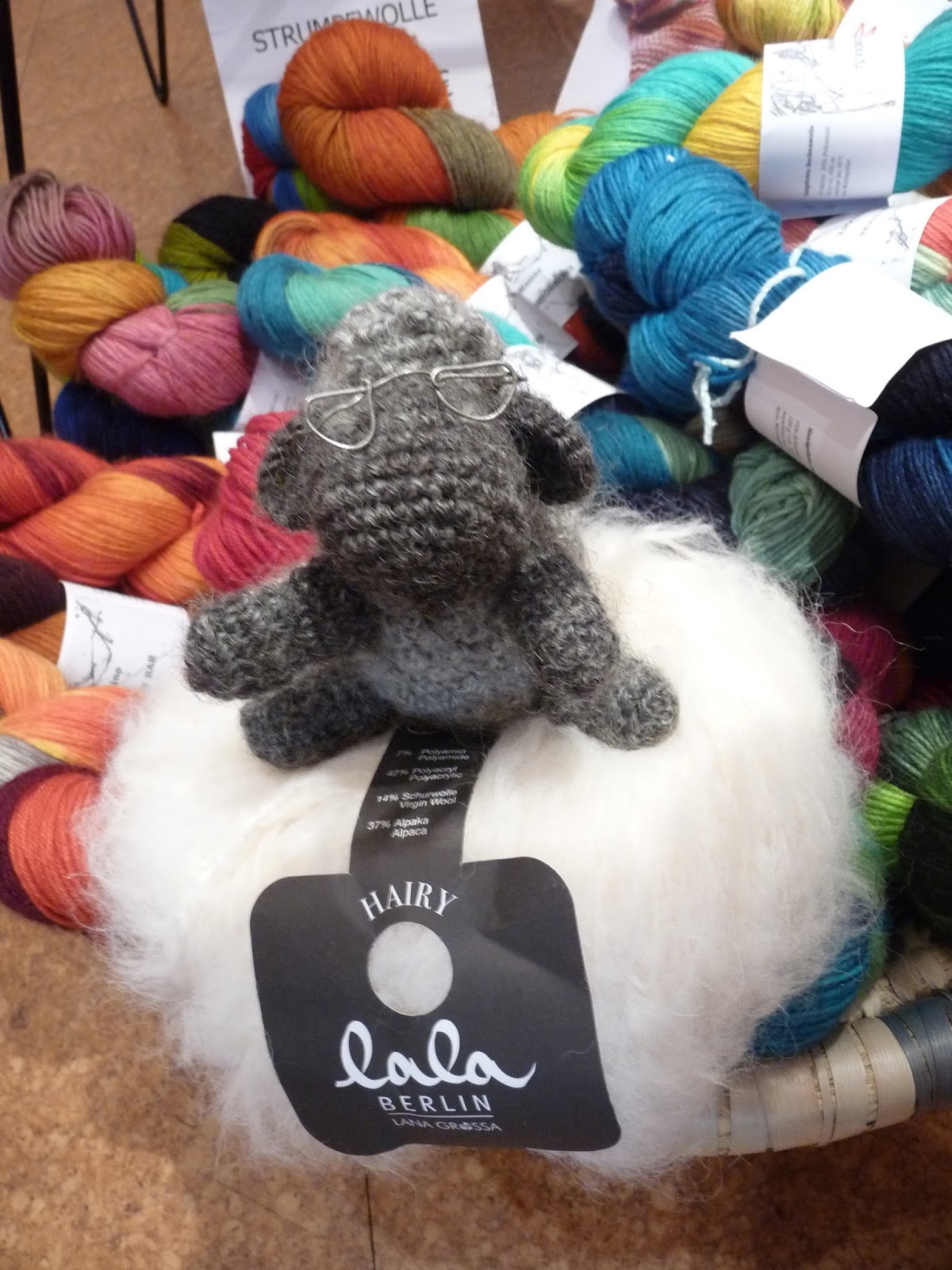
"Stop sitting on your Hairy Lala, Elinor, I am now desperate for that coffee."
"Untwist your knickers, Beaut, I know just the cafe and there's somebody there I want you to meet."
As the waiter brought our tray, an enigmatic figure, muffled up in golden fleece, approached the table on long, ginger legs.
"Elinorchen!"  
"Hiya, Foxy!" The two ewes exchanged air kisses.  Foxy originally came from Coburg, in Bavaria, her family being the Fuchschaf, an ancient line of German sheep.  I felt a little shy of asking about her wunderschon fleece, but Elinor charged straight in.
"Fran here wants to buy your wool, Beaut."
"Naturlich.  It is only in the best shop. Manufactum."
We left them deep in decades of gossip. Manufactum is the shop for quality products, many made in Germany.  If you've got a few bob, you'll have no trouble spending it.  Good job they only have a small selection of yarn.


More woolly gratification was to come.  On Sunday, at the Flea Market in Mauer Park, there was a stall selling gorgeous sheepskin rugs from the mountain sheep of Poland. The one I bought could easily be mistaken for a bear.  Sitting on it to drink our Gluhwein, watch the people and listen to the band, we wondered if Warsaw might not be a more rewarding destination for the fibre enthusiast. 
Obstacles notwithstanding, our trip to Berlin couldn't have been better. BG said she preferred the street art to the galleries we never visited and has come home inspired to redecorate her garden wall with revolutionary graffitti.  I am moved to quote Goethe.  

"Auch aus Steinen, die in den Weg gelegt werden, kann man Schones bauen."

Friday, 9 October 2015

Contact Dyeing with Eucalyptus Leaves and Iron

"They lasted well, these lovely autumnal flowers.  Shame their leaves are falling now."  I emptied the vase into the sink.
"Pooh, that water stinks.  Take those festering stalks down the compost heap."  As I carried them outside, my companion called after me "I like a sweet scented bouquet, Beaut.  Give me roses and lilies, any time of year, Christmas included."


Sometimes that ewe pushes me too far.
"They weren't sent to you, Elinor, himself was given the flowers from his work. And you can shut up about Christmas, some of us like to enjoy things in their proper season.  Sure, the florist didn't pick those chysanths from her own garden, but she did a nice job of making the arrangement look as if she had."
"Are you having a laugh, Beaut?  Half the greenery in that bunch was eucalyptus.  Probably travelled half way round the world."
Elinor was exaggerating about the amount, but not wrong about the leaves.  Salvaging three sprigs of eucalyptus, a bit dried out and turning a rusty orange, I was thrilled. Anyone with an interest in contact dyeing with plants must have seen all those on line images of dramatically coloured eucalyptus leaf prints.  


For several years I have been eyeing up the two kinds of eucalyptus growing in my neighbour's garden, even more tempting since they have grown so quickly that leaves are hanging over the wall.  My natural nobility of conscience has prevented me from pinching any. Well, that and the fact that I've read that leaves from trees grown in the UK don't get enough sun to produce rich colours.
Ringing on the doorbell to make my odd request, I was greeted with such kindness.  Without a pause to ask why I wanted her eucalyptus, that lady had the secateurs out and was clipping off branches.  I have also read that the fallen, dry leaves are best, but bother that, time to mordant some silk with alum and find out what colours my three types of cut eucalyptus leaves had to offer.


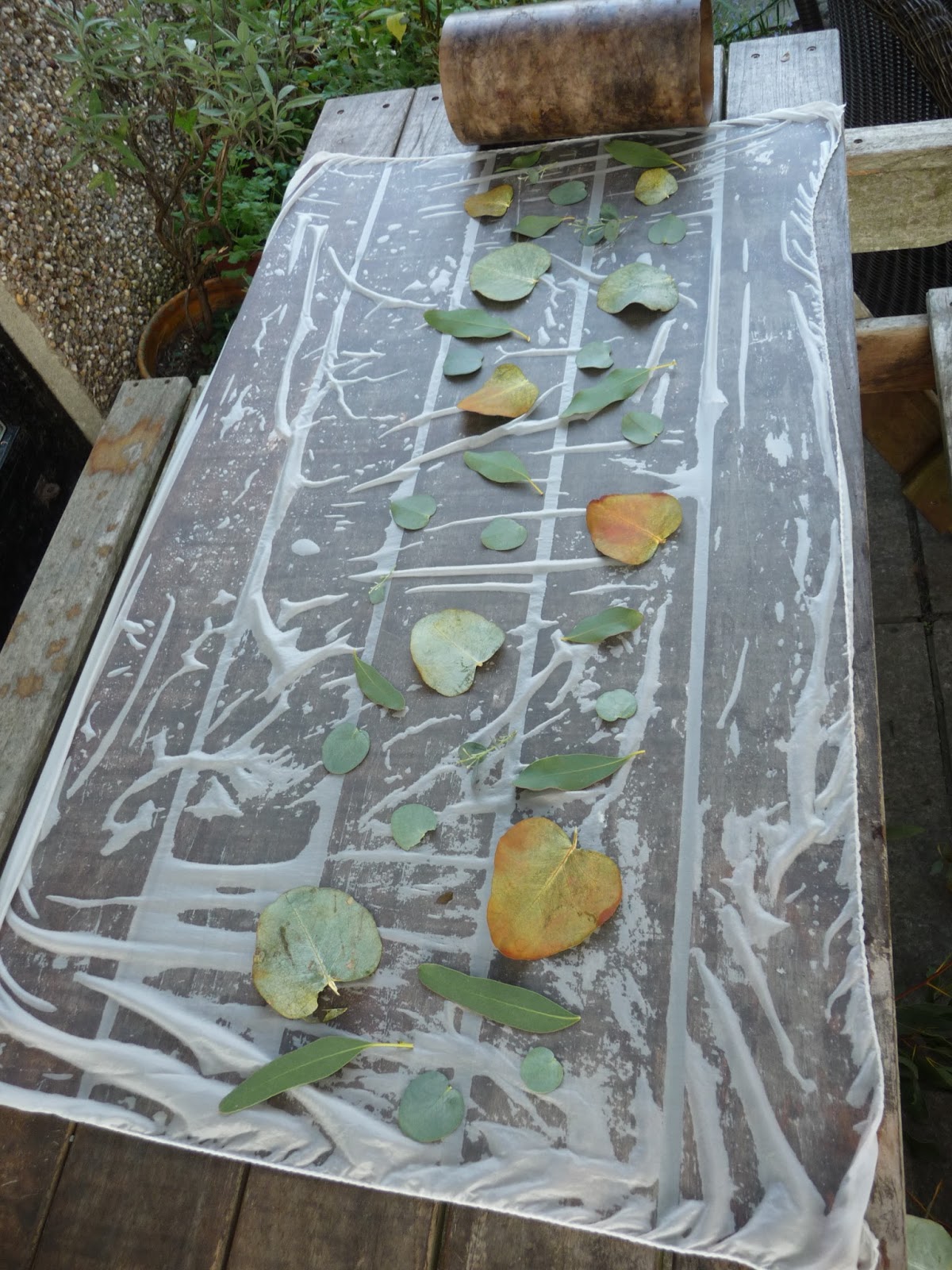
Laying out some leaves, I folded the wet silk over and tried to place the same kind of leaf in the same place on the next layer, to sandwich the material for maximum dye absorbtion. Folding one more time, a couple of rusty nails and washers went in amongst some more mixed leaves, another thing I haven't given a proper trial before.  The silk was rolled up around a length of plastic drainpipe and tied up tightly with some string that had been soaking in a pot of water with rusty nails. Since there was already iron water in the yarrow plant dye afterbath I happened to have lurking about the patio, that did tot up to an awful lot of iron. Stuffing into the pot some extra prunings from a huge achillea plant
to supplement the dyebath, the bundle was simmered well below the boil for several hours. Next day it emerged looking very dark and was left to dry out in the greenhouse for a couple of days.  My ecobundles only get a really long time to cure if I forget about them and it doesn't seem to me to make a huge difference.  As it goes, this one was still a bit damp in the middle when I unrolled it.

The rusty nails had made really black splodges. The florist's eucalyptus gave orange and both the local types green prints.


After rinsing and a proper wash with a pH neutral liquid, a press with the steam iron revealed the final eucalyptus leaf and iron patterns.  Elinor always takes an interest in silk, clambering about among the leftover branches like some frisky Welsh koala bear looking for lunch up a gum tree.

"Best you pop over the road and invite your neighbour round for coffee, Beaut. These little round green leaf prints would suit me beautifully, dyed on a pink background.  Gales are forecast and there's bound to be some stag's horn lichen blown down for you to ferment."
"A very seasonal thought.  On the other hand, maybe you could buy me some flowers."