Showing posts with label Spinning Equipment. Show all posts

Friday, 25 March 2016

Spinning Cashmere and Trying Out a Blending Board

Wonderwool Wales is only a matter of weeks away.  The moment the doors were opened on the 2015 show,  I brutally elbowed off slower moving spinners in my hurry to buy Qaria cashmere from Mandacrafts stall. Recently, I realised that if I didn't pluck up the gumption to spin it soon, it was going to be very hard to justify realising my dreams of a 2016 splurge on qiviut.  

Not long after I brought the cashmere home in triumph, my companion, Elinor Gotland, came across the bags while nosing through my stash. 
"I'm not being funny, Beaut, but look at the staple length.  How can you spin that?"
"Manda advised longdraw."
"Hardly your strong suit.  Especially with a maximum 15:1 ratio on your wheel.  You'll be pedalling harder than Geraint Thomas up the Pyrenees, to put in enough twist to hold these tiny fibres together."
"Well, I'll just keep it in a bowl to admire while I practice on some short stapled Ryeland. Whatever happens, I'll consider my money well spent, supporting such a worthwhile social enterprise. The least I can do, compared to Manda, she went all the way to Kabul to show the Afghani women how to spin cashmere finely.  Look, you can see her in the first picture on this page.  How intrepid is that?"
"Mmm.  Nice outfit she's got on.  Of course," she said, airily, "I have done a bit of spinning in Kabul myself."  I turned from the computer screen to look at her, eyes popping.  Elinor hurried on.  "Oh, it was just a stopover on a long haul flight.  I met such handsome, charming Afghani goats, two brothers, Ezat and Nadir.  So hospitable, they'd give you the coat off their backs.  Literally."
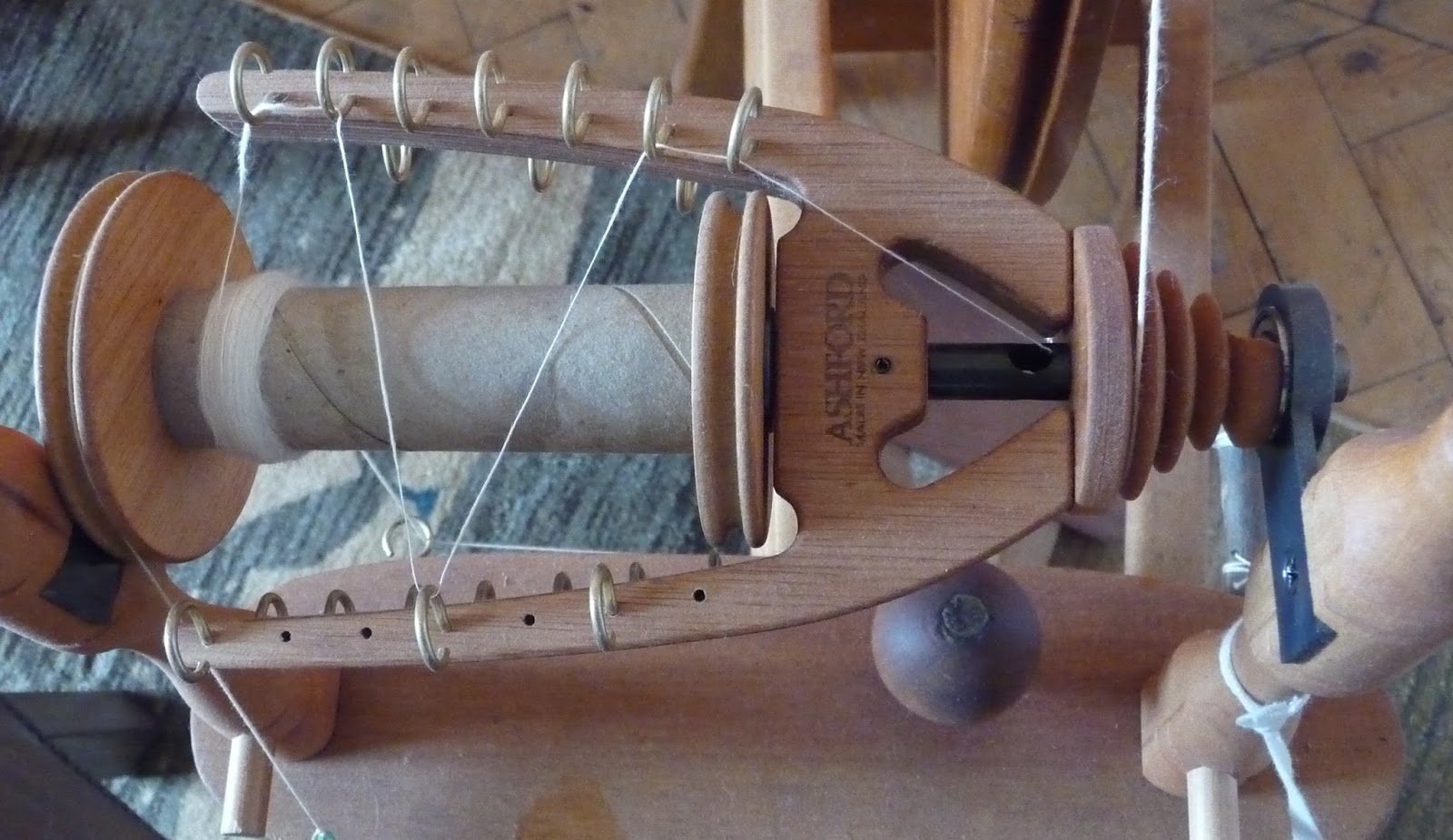

Over the summer, I managed to hide the disappointing yarn I spun longdraw from small rolags of coloured Ryeland.  Harder to conceal the hash I made of fitting a fast flyer to an old Ashford Traditional wheel I had refurbished.
"Oh, you've forced it on willy nilly and now the littlest whorl has cracked."
"I know!  And I don't understand all the ratios and drive band stuff and I can't get the damn thing to spin right and I think I'll go to bed.  OK?"
"Ooo, someone slid down the learning curve." said Elinor.  Exit, pursued by a bear.

Giving up on skinny rolags and high wheel ratios, for this Spring's return to the attack, I returned to Roger, my faithful workhorse Ashford Traveller and I did spin two 25g singles of white cashmere by teasing fibres out from the cloud, centimetre by centimetre, and pedalling like the clappers.  I cannot pretend this was a wildly rewarding experience.  I finished the second at spinning camp, a couple of weeks ago, where a very kind soul allowed me to use her e-spinner, which simply flew, plying those fine singles together with adequate twist.  Another spinner tactfully pointed out a fundamental flaw in my plying action and the result was 50g fingering weight cashmere yarn, not as lofty as I'd like, nor as even, but ready to knit.


Recovering from a cold and still feeling grim, regretfully, all I had brought for the rest of the weekend's spinning was another bag of cashmere and some silk. Sampling half a dozen flavours of fruit gin lifted my spirits considerably, as did the fantastic food and good company.  Coming to my resue, one spinner lent me her blending board and another just gave me 100g of Down-type wool tops, setting me up for a happy day making pulags, our
name for those fibre sausages, half way between a cotton puni and a hand carded rolag.  First, weigh and divide the fibre into 10g portions.  Each of mine had 2.5g cashmere, 2.5g silk and 5g wool tops.  Laying on the tops and trapping the tips with the flat of the hand, you pull back the bulk of the fibre to stretch out a thin layer on the tines of the carding cloth. Next, a layer of silk went on in
random stripes, then the short stapled cashmere was rubbed acoss the cloth, depositing a haze of fibres with occasional clumps.  A flicker is used to smooth the three layers down, its teeth aligned with the tines, rather than locking with them.  Building up layers is repetitve, but soothing. Once 10g fibres have been applied, you swing the board round so its short edge faces you, trap the loose ends between two
sticks and roll up, not too tightly, gently lifting the sheet of fibres away from the board by levering up with your thumbs.  Slide out one stick, then the other and there is a finished pulag.  Immensely satisfying, much admired and compared to silver birch branches, I was still glad to come to the end of my fibre, it having taken best part of the day to complete 21 pulags.


Spinners do like to chortle, even before the fruit gin comes out.  This group now has a Ravelry Forum called The Pulag Archipelago. Come and look, better join us soon, before someone implements those suggestions for a stringent entrance exam, as Elinor Gotland has set herself up as team disciplinarian.


Finally, a real beauty shot.  Speckled Face Beulah twins, born this morning and already bouncing.  The ewe is a first time mum, gave birth with no trouble and must be giving her lambs good energy-packed milk.  See how proud she looks? What a girl.

Friday, 8 January 2016

Doing Up an Ashford Indian Spinner/Country Spinner Mark 1

My friend BG uses wool to make art. In her eyes, kempy old sheepswool locks and matted beige bits from dodgy plant dye experiments are just inspiring raw materials, which saves me grieving over foolish purchases and failures and generally makes for a happy symbiosis. Nonetheless, for Christmas 2014, I was sure her life would be enhanced by possession of a spinning wheel, if only I could find the right one, at the right price.  BG's ideal wheel would definitely need to cope with big art yarn and minimal maintenance, so when a friend of ours pointed me towards this Ashford Mark 1 Country Spinner on eBay, I zipped in with a bid of £65, despite the seller's remarks about it having woodworm.
My sister met a pack of big dogs living on the farm when she drove there, in the dark, to fetch the wheel home for me.  Once it had had a good scrub, the wood looked scarred, but intrinsically sound.  The damage looks more like teeth marks of a puppy, probably now grown up into one of those big dogs.  The Ashford logo was clearly stamped on the front and the Ashford website listed
this model under the name Indian Spinner, made between 1980-86, confirmed by the original assembly instructions.  I used those instructions to take it apart and put it back together after applying three coats of Danish Oil, poured oil on all the moving parts and bought a new 10mm nut to replace the only missing bit.  How smart it looked!  I named it 'Twice Shy' (as in once bitten) and tied a leader onto the bobbin, ready to present to BG with a great Ta Da!!
Small snag - I couldn't see how to get this wheel to spin yarn.  I thought I must have reassembled it all wrong, because the mechanism baffled me.  The one huge bobbin has a whorl fixed to its back and the weight of the big wheel itself actually hangs off that via the drive band. Unlike my scotch tension Ashford Traveller, the flyer has no evident link to the turning of the wheel, just a brake band running over the orifice.
  
Though BG had to wait til spinning camp in March to have a confident tutor, this wheel did prove entirely functional, just treadle away and you soon get the hang of it. By Easter, she had spun a dozen balls of superbulky yarn and developed thighs like nut crackers. BG fed massive amounts of fleece into its gaping orifice and as I imagined, did love making wild, thick yarn, though apart from pure capacity, the Indian still seemed to me a rather daft wheel design.  Not only is it heavy to treadle, there is only the one bobbin.  Unless you know how to make single yarn (which I don't), a spun single has to be wound back off the bobbin and rolled into a ball, before you spin the second single. Then the second single has to be wound off and balled, before you can finally ply the two singles together and finish your yarn.  It was only recently that it occurred to me to ask to borrow it, specially for a heavy weight plying job.
Resolving to catalogue, organise and use up my stash of wool, I have so far only got as far as the very first fleece I ever spun.  The Huxtable Jumper has not had much wear, being heavy, hot and well, the post-apocalyptic look is so dystopian.  Once unravelled, I found the yarn was soft and weak with incredibly loose plying, which rather explained why the fibres were already pilling.
I also rediscovered a half formed
bag in hibernation.  This yarn was a fascinating and thoughtful gift, a huge egg of tough, highly energetic Z twist single Karakul sheep wool, brought back for me from Samarkand.  Maybe it was intended for warping a rug. Crocheting with it proved so hard on the hands, the original project got abandoned. 
With Roger, my Ashford Traveller,
spinning clockwise on the 15:1 ratio, I took the S ply out of the Huxtable yarn and added plenty more Z twist.  Pulling this straight back off Roger's jumbo bobbin and plying it anticlockwise with the Karakul yarn from the ball, the Indian Spinner did sterling duty. With both feet on the single treadle, I could spin the wheel til the bobbin was nearly half full. Doing this ten times gave me a good workout, though the effort it took suggested my core strength must be dismal. I simply couldn't 
get up enough power to shift the weight of a full bobbin.  Close inspection showed the final yarn was around 5-6 wpi.  The weight was shocking - 10m weighed 22g. No wonder that was hard work. Still, I now have a high grist yarn which ought to combine durability with all the colours I so admired in my first Jacob X Texel fleece. The latter has also added enough softness to crochet without taking the skin off my knuckles.

Friday, 31 January 2014

January Blues - Woad Invictus

January always finds me at a very low ebb, fed up with dragging my carcass to the car before day breaks, only to find it dark again by the time I get home.  I spent time last summer precipitating woad pigment I had extracted from the plants in my garden.  Capturing some of that cerulean blue was an investment against just this kind of rainy day.
Out of the night that covers me,
Black as the Pit, from pole to pole,
I thank whatever gods may be
For my precipitated woad.
Not knowing how much woad was stored, in advance, I soaked a wide array of yarn and fleece, undyed or disappointingly beige and ripe for a spot of experimental overdyeing.  I supposed that just stirring my precipitate into a little water would be the equivalent of making a paste with woad powder and I alkalinised it with dissolved soda ash, as per instructions which have worked out fine, before.
Instead of becoming a dark cloud, flooding from my jam jar into the dye bath water, the woad precipitated straight back down.  Trying to squish and stir it up, no amount of parboiling my arm in water at 50 degrees centigrade made a bit of difference.  I'd like to say that In the fell clutch of circumstance, I have not winced or cried aloud.  In truth, I cannot hold a candle to William Ernest Henley.  
I did salvage some, by pouring the whole pot through a sieve, lined with a piece of silk.  Lots went down the plughole.  All that effort, growing and saving woad, to end like this. Under the bludgeonings of chance, I took the dog down the beach to scream with the seagulls.  The dog is deaf and quite unperturbed.  Home, much restored.

After I had flaked the dried woad back off the silk, I came across an article about making your own paint.  It described grinding mineral pigments together with linseed oil. Got some of that in the garage.  Woad paint seemed a better option than another attempt at dyeing. Mixed up, the colour was darkest indigo and the paint needed to be thinned with a fair bit of oil to go on smoothly with a brush.


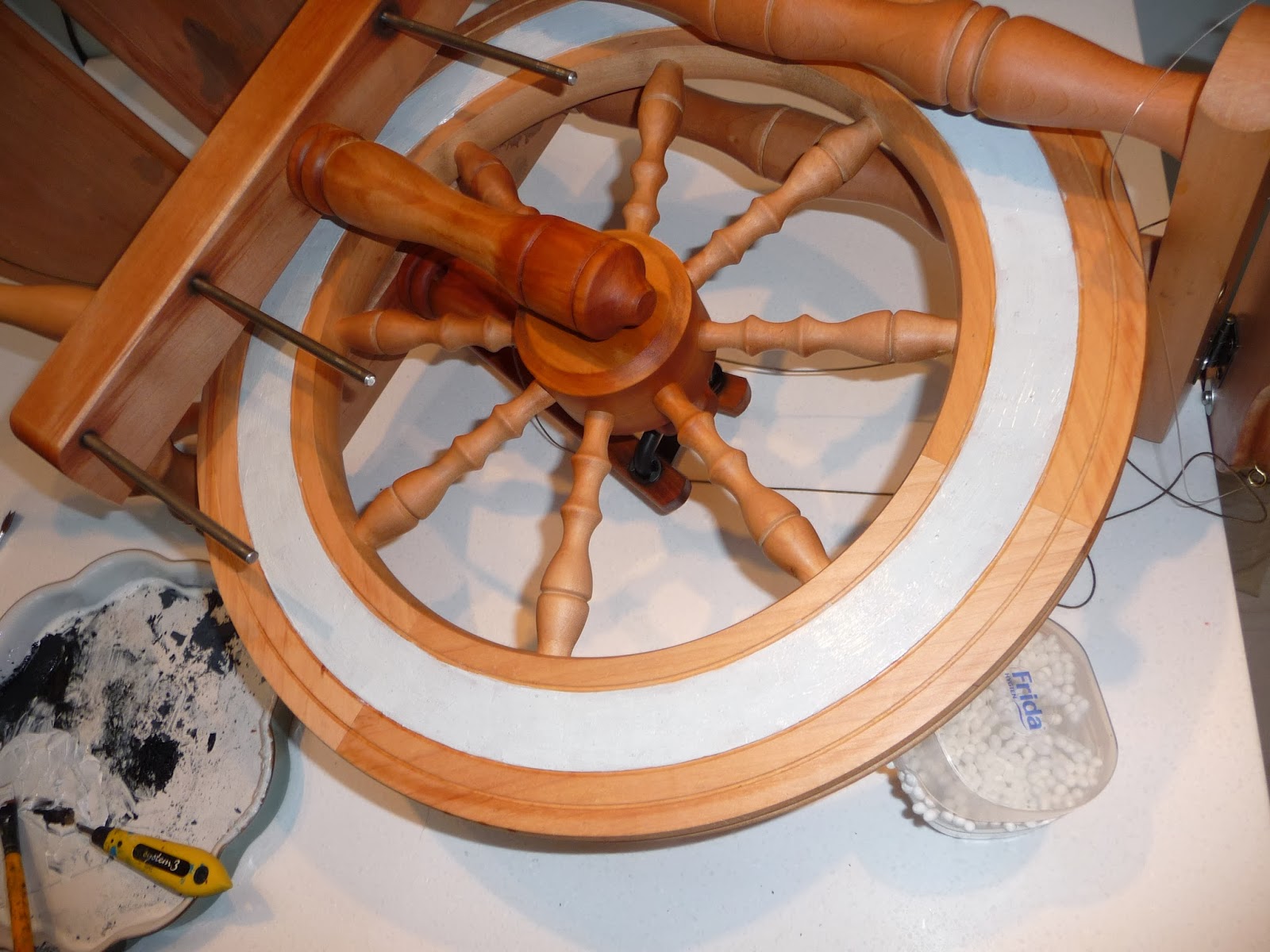
At the end of January, it will be one year since my spinning wheel, Roger, rose from the flatpack.  I bought the barewood version of the Ashford Traveller with a vague idea of customising it.  Desperate as I was to get spinning, all he actually got was a rub down with beeswax wood balsam before going into service.  He gets another wipe and wax every time we finish a fleece, but also bears the stains of my liberal use of bicycle oil on his moving parts. Decoration with woad paint spirals would be a fine anniversary celebration. What I lack in artistic genius might be remedied with a potato print.  The carved carrots worked out rather well.
I sanded down an old bread board for a trial run.  The spiral prints weren't very crisp, but the principle seemed sound. When the paint dried, I discovered that the oil had just dumped a residue of woad powder on the surface. Touch it and it blurred.


Beyond this print of linseed oil 
Looms but the Horror of decay,
And yet the thought of spirals spoiled 
Finds me resigned to modern ways.

Bugger macrobiotic, wholemeal choices.  Time for a big blob of white acrylic paint.

Ha, finally fixed that woad.  Roger got two layers of a pale blue-gray shade.  Spirals are my favourite doodle.  Triple centres are a good symbol for spinning, one twist for the single, one for the ply and another for rolling yarn into a ball.  George Bain's The Methods of Construction is a brilliant book that enables anyone to fathom how to put patterns together. 

I practiced on paper, cut out a template, mixed a darker shade of woad paint and spent ages laboriously painting on a linked spiral design.  The brushwork is dodgy, but the process got hypnotic.  I did both sides and used up the rest of the paint on the bobbins.  It turns out spirals may have all sorts of symbolic significance, far removed from spinning.  Have a google, see for yourself.
Where do people get the effrontery to imagine they can pontificate on the meanings of spirals carved thousands of years ago? Might just as plausibly suggest that people then liked doodling too.  It is hideously annoying when supposition and guesswork is presented as fact. 

Ah, January, good job it is nearly over.


It matters not, how woad is fixed,
Though acrylic was not my ideal.
I am the master of this mix:


I am the painter of my wheel.


Friday, 17 January 2014

Making a Woven Willow Sheep Fleece Basket

Willow grows fast.  In 2002, I planted different coloured rods to grow a living willow dome for the kids to play in the back garden. Despite weaving ends in and pruning, by 2010, it had put half the garden in deep shade. Chopping the top off left this wildly intertwined enclosure. Each spring, the new growth is so vigorous that egg chair is quite private by summer.
Push the end of a freshly cut willow rod into the earth and chances are, it will take root.  I've used willow to make wigwams for climbing plants and found the wigwam in leaf before the sweet peas flowered.  Salix viminalis is a complete monster, the Golden Willow, salix alba x fragilis is slower growing.  Even so, a row of its cuttings planted a few years ago needed a hard winter pruning.  The colours of willow bark are beautiful in January.  First thoughts ran to trying it as a dye, but then I remembered the mystery object from Handspinning News.

The object turned out to be a willow basket for raw sheep fleece, possibly for warming the lanolin by the fireside before carding, possibly for gathering bits of loose fleece. Variously known as a crealagh, muirlag or ciarachan, discussions on Ravelry gave links to Woven Communities website, where there is a phototutorial called How to make a Mudag.   Some years ago, I tried willow weaving, following instructions in a book called Handmade Baskets by Susie Vaughan.  I've never made a frame basket, but with all this willow, what did I have to lose? I managed to tape four lengths into hoops and put them in a round trug to dry. Last Saturday, when I took them out, they stayed reasonably circular.  All the other lengths had been rolled in a towel and were sodden with rain.  This had made them much more flexible than when I cut them.

Even so, I had to split one of the thinnest twigs down the middle to make it bendy enough to wrap the cut ends of the hoop together when I took off the tape.  Not possible to tie a knot, so I put the thin end between the layers of the hoop and bound back over it, then pulled the thick end between the layers to wedge it tight. .
There is a diagram for the God's Eye on Woven Communities. To get a long enough, supple enough length for this, I peeled a thick layer of bark off one of the biggest sticks. To finish, the loose end was pulled through the last turn and woven against the adjacent rib as I made the body.  The God's Eye was a godsend when it came to fitting all the ribs.  In the picture of the real thing, a single in and out weave is used, which needs an odd number of uprights. Three ribs per quarter sat safely and looked good, adding or removing one just didn't work.
The God's Eyes were wide and firm enough to support the ribs under their own tension, when bent into place. 
Having sixteen ribs, I decided to weave with a pair of willow lengths twisting round each other in between each stake.  I don't know what this is called, but it is the basic technique shown in 'Handmade Baskets' and it does work for any number of ribs. Once I had made a start on both ends, I took the tape off and it held perfectly solid.  


By this point it was getting dark, my hands were aching and my feet freezing from sitting still, but I was most encouraged.  Completing the body, it was touch and go whether there would be enough lengths of willow.  To fill in the middle, I had to resort to using up weedy bits which were too short, really, or the thickest ones which didn't want to bend neatly.
By Sunday teatime, I had a finished object.  It is strong and can withstand maltreatment by those who have noticed its likeness to a rugby ball and think it funny to toss it round the kitchen while I squeak with alarmed outrage. The golden willow is bound to fade to brown and shrink a bit. The whole thing already has an amateur wonkiness, but I am chuffed.   

My own muirlag.  Time to find out whether carding warm wool is easier. I might try it out collecting bits off fleece off the moor next May. 

It certainly makes a better fireside ornament than wet boots.