Showing posts with label Hand Spinning. Show all posts

Friday, 5 July 2019

A Coloured Romney Fleece to Spin


A trip to the Somerset Guild Fleece Fair was the highlight of this year's June Spinning Camp. After a week of rainy days and nights spent listening to the tent flap around me like a washing machine, Saturday dawned fine and full of promise. My last set of clean clothes had remained presentable, even the complicated journey along the lanes across the levels went without a single wrong turn, arriving at Hatch Beauchamp just as the Fair opened. Two friends on the inside, experienced Guild members both, had promised to keep a look out for the perfect grey fleece while the farmers were setting out their stands. As the doors opened, they steered me straight towards it.


Back at home, I looked up from unrolling my Romney on the lawn.
"That one's a beauty, but it wasn't the best fleece there, was it Beaut?"
"How did you work that out, Elinor?"
My companion shrugged.
"Call it intuition. You look one plastic toy short of a Happy Meal."
True enough, even as I arrived at the Ashbury Romney's stand, somebody else had got her purse out and was paying for the exact fleece my friends had pointed out. No matter, the farmer, Philip Prouse, had plenty of other gorgeous specimens for me to choose from.
Surveying my new purchase, I picked off a few wisps of hay.
"I was entirely satisfied when I found this beautiful clean, soft, variegated grey, shearling coloured Romney sheep fleece and it looks just as good now as I when I stashed it in the car boot." 
"So what's eating you?"
I sighed.
"After I bought it, I met another friend from camp who had a stand in the marquee. She'd nipped into the hall before the show actually opened and bought an even finer, absolutely amazing silvery grey Romney. It was under her table and she showed me."
My companion roared with laughter.
"Don't let the green eyed monster steal your joy, Beaut."


Soon as my sleeping bag was rinsed and drying on the line, I set to skirting the edges of the fleece. It's a shame the darkest colours are always on the shorter leg and belly wool which gets most matted, but this big fleece had few second cuts and no weak points in open locks with a staple of from 10 to 15cm.
Lustre gleamed along the even crimp. I'd have been happy to spin this fleece with no preparation, just picking apart the freshly shorn locks. Still, having a couple of weeks in hand before the Tour de Fleece, though I hadn't got a suint vat fermented, I decided to set one up for the summer by soaking the Romney for a week in a 90 litre container of cold water.
After one more day having a second rinse in fresh water then a couple of days drying out, the fleece had lost most of its dirt and much of its smell, though a moderate amount of lanolin remained. Though the colour variegations could be split into many shades of grey, I divided it into three broad categories. There was never any real doubt in my mind, there would be no combing or carding the wool, this fleece was begging to be spun from the lock.
Just a few bounces with the flicker was enough to open the tips and butts of the locks. With a small pile of locks prepared, I tried four options, results shown on the card below, described left to right.
Spinning from the fold longdraw, pointing my finger at the orifice of the spinning wheel and pulling backwards was the quickest process, though spinning from the fold short forward draw, with my finger at right angles to the orifice, gave a smoother and more even yarn. Spinning from the butts or the tips produced yarns somewhere in the middle.


I spun samples in fingering weight and chunky to compare. 
"The worsted effect from spinning forward from the fold works well at any weight of yarn, but I think I'd best spin chunky three ply for a thick jacket. This Romney is lovely, but not quite next to the skin soft for knitting the thin cardi I had in mind." 
I heaved a sigh and my companion looked stern.
"Old Green Eyes, stop pining for that fleece you didn't buy. Make a friend of this one."
I've taken Elinor's advice. And I've used the fingering weight Romney sample to make her a friend with green eyes. 


Friday, 15 March 2019

Spinning Shetland Wool Tops


My companion watched me stuff all my yarn back into hiding. Few balls were made of really tough, durable fibres and none of them had a long colour change. I knew that really, I'd just been checking. I sighed.
"How is it that I never own exactly the yarn I need?"
"Face it, Beaut, you're addicted to knitting those entrelac bags. No quick fix, if you want to make another one, you'll have to spin some of this wool first." 
Turning to my fleece stash, plenty of the raw wool looked hard wearing enough to become a bag, but I'd failed to get it washed while the sun shone last summer. I did find four bumps of combed Shetland wool tops in natural colours. Being coarser than I'd expected when I bought them online, these had been facing an uncertain future from under the bed.
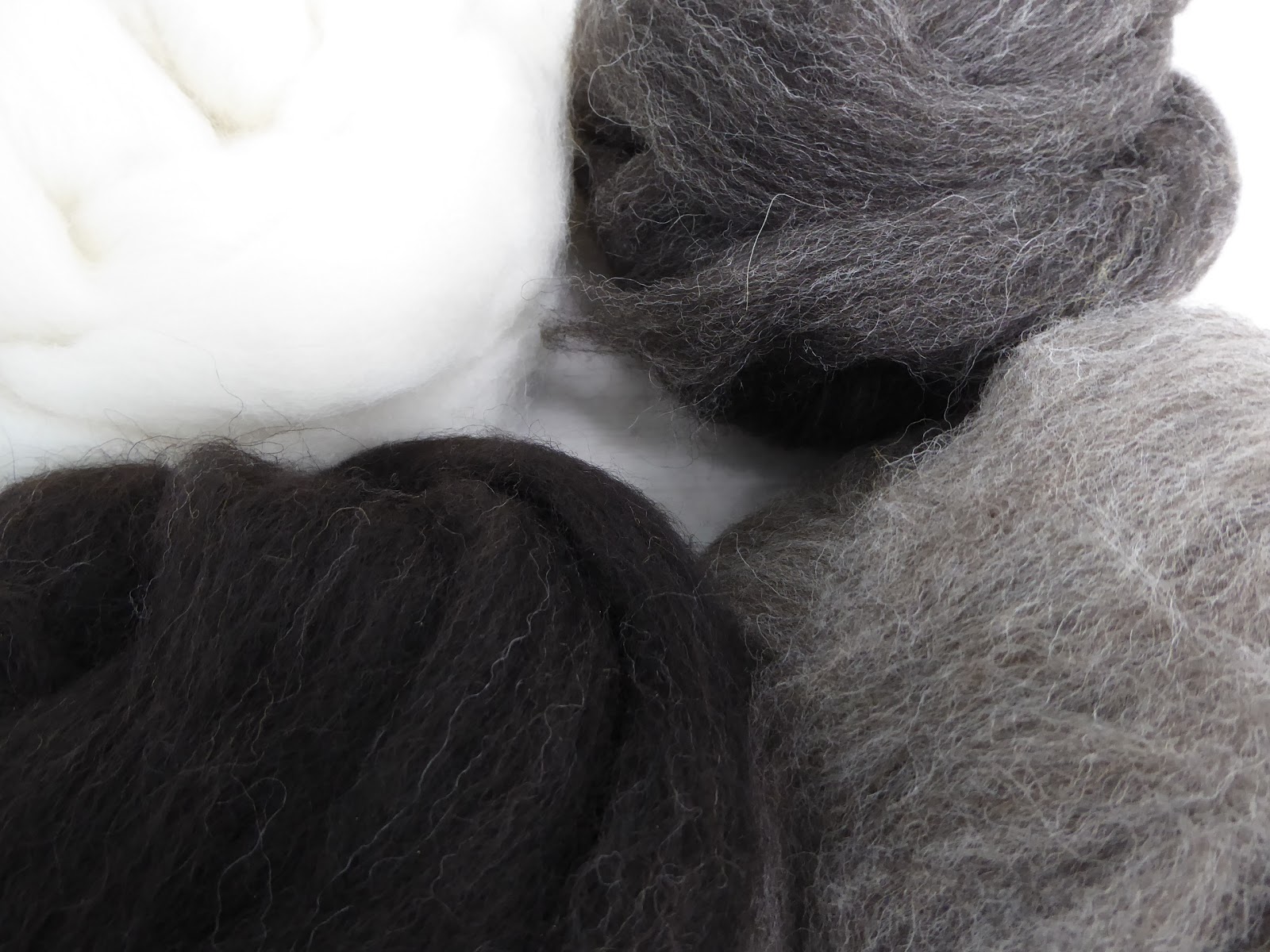
Shetland sheep grow a wonderful range of coloured fleece and the tops were intended for making cosy thrums, only the hat I made with them turned out really itchy. On closer inspection, the white wool looked and felt considerably finer and softer than the other colours, the dark chocolate being next softest while the faun and grey felt properly hairy. OK for a bag though.

Spinning on a high ratio, I spun short forward draw with high twist, aiming for a dense, smooth yarn. After spinning a 20cm portion of one colour of tops, I tore off a short piece of another and blended it roughly with the first, just by splitting and drafting the two between my hands. The resulting single had the sort of long colour change I so enjoy knitting as entrelac.
It wasn't until I had chain plied the first bobbin that I noticed I'd also spun a long weight change. Watching the Six Nations Rugby on telly, it wasn't the exciting moments of the games that had affected my drafting, so much as the different qualities of the four Shetland tops. The coarser fibres had tended to run more thickly through my fingers and once three plied, that effect had been trebled.
The white sections of the yarn had turned out about double knitting weight, while the faun and grey were nearer aran. Even when paying greater attention while spinning the next bobbin, consciously aiming to draft all the colours equally, this intrinsic tendency of the fibres to do their own thing proved surprisingly hard to correct. After spinning four 50g skeins of irregular weight yarn, I was still fighting the tide.
"I've had it with spinning this Shetland, Elinor. I'm going to start knitting. There's enough yarn here for a small bag in sepia shades. Call it a rustic clutch."
"Which sounds like the last dance at the village hall, only less fun. You've been craving the thrill of entrelac colour play, don't give up now, mordant that yarn and make it fabulous."

I'm not sure how spectacular an uneven, natural coloured, tightly spun Shetland yarn can become, but I'm giving it my best shot. Never say dye.

Friday, 8 March 2019

Spinning a Durable, Long Colour Change Yarn from an Indie Dyed Braid

"This craft room looks like a bomb site, Beaut." 
My companion, Elinor Entrelac Gotland, stood in the doorway with a cup of tea in her outstretched hoof. Sitting back on my heels to reach for the cup, I managed to spill tea on a heap of plant dyed fleece. I winced and my companion shrugged. 
"To be honest, those colours look mouldy anyway. Tea could only improve them."
"Well, it's not the right wool to take on the Cronkhill spinning weekend. I want to spin tough yarn to make a firmly shaped bag and that Down type fleece would be too bouncy and elastic. This coreopsis-dyed Polwarth is a great colour, but much too soft." I opened another box and pulled out a handful of corkscrew locks. "If I combed some Wensleydale it would be strong and smooth, only this isn't dyed yet and I want to spin a long colour change yarn."
"How about these?" Elinor profferred two 100g braids of fibre dyed by HilltopCloud. I read the label.
"Oooh, perfect. A blend of Romney wool, silk and linen, all smooth, durable fibres and I love the colours. Is this what you'll be spinning at Cronkhill?"
"You can have it. I'm not coming, Beaut. Got a better offer."
I clutched the gorgeous braids of fibre, both delighted and baffled. What could be better than a weekend away with friends, spinning, drinking Damson Gin and nosing round Shrewsbury? Elinor started humming Calon Lan.
"Go on then, tell me."
"I've been given a ticket for the Six Nations Rugby. This Saturday, I'll be rubbing shoulders with Sam Warburton in the South Stand Lounge at the Principality Stadium, drinking champagne and watching Wales v England." 
I wasn't sure Elinor would be tall enough to rub shoulders with any of the players, but she was chuffed to bits and so was I. 


While the crowd were singing Hymns and Arias in Cardiff, I was sitting in an English farmhouse spinning short forward draw with high twist, drafting to and fro across the top of the braid to make my single transition as slowly as possible from one colour to the next. Chain plied with equally high twist, the yarn turned out smooth and as hard and inelastic as string. Although only aran weight, the grist was so high that 50g fibre made only 56m yarn. Somewhat to my chagrin, despite best efforts, the colour changes in the yarn were of only moderate length and muddier than the braid. On the upside, news of a convincing victory for Wales had me bouncing on the sofa, discommoding adjacent spinners.
It took my companion several days to recover from emotional exhaustion brought on by the rugby. Once she had her voice back, she asked to see what I'd done with her braids.
"Fair play, Beaut, that yarn is harder than JPR Williams. There'll be years of wear in that."
Knitted on 3.5mm needles to create a tight fabric, I think the six stitch squares of entrelac have given the best possible definition to the colour changes.
Using two inch jute upholstery webbing and the same construction method as for the first bag, yarn spun from the second braid was knitted into covers for the brim and the handles. I knew the bag was a success when I found Elinor packing it with her overnight things to fly up to Edinburgh. I'm led to believe that she's been invited to sing Ar Hyd Y Nos at tomorrow's game with the troubadour of Wales, Max Boyce.


Friday, 12 October 2018

A Welsh Mule Fleece for Britspin

My companion, Elinor Gotland, looked up in surprise when she heard the car turn into the drive.
"That was quick. I thought you'd be bound to get lost on the mountain."

"Well, I nearly was. When the thing on my phone told me I had 'reached my destination', I just stopped in the middle of the lane to climb up for a look over the hedge and as luck would have it, the farmer came past in a four by four and told me where to find the track to the house."
Elinor looked at the mud splattered car.
"Rough going was it?"
"Not as rough as the fleeces." I shut the boot and carried a large bag into the garden. "When somebody is kind enough to ring up after shearing and offer me a gift, I know it would be too rude to say no, but going through that wool sack this morning was an odoriferous experience. Beautiful views from the shed, though."
"Let's have a look at what you picked, then."
I unrolled a coloured Welsh Mule sheep fleece onto the lawn.


"I wondered about choosing a fleece that was practically cotted solid, to try making a rug, but then, right at the bottom of the sack, I found this. There's not much debris in it and I do like the colour. Thought I might use it to make a new handbag."
"Ooo, you're so ungrateful. This is a lovely open fleece. See how it stretches into windows." Elinor pulled out a lock and twanged it. "No breaks in the staple, fine fibres, tight crimp and maybe even a bit of a lustre. I'd say this ewe inherited some great Blue Faced Leicester qualities from her dad."
I circled the fleece, pulling off the shorter, rougher locks from round the edges.
"That's a brutal skirting you're giving that fleece, Beaut. It's not so long ago you thought every lock was precious. How times have changed."
"I might just spin it in the grease, make some rustic, chunky yarn."
My companion put down her hoof.
"Now that attitude is one thing that ought to change. This is a nice fleece and you are going to do it justice and prepare it properly. It can be your Britspin project."


First, the fleece was divided into three portions, put into three large net bags and soaked for 24 hours in the suint vat. Under the watchful eye of my companion, the dirty water was spun out in the spin dryer and each bag was soaked for ten minutes in a bucket of hot soapy water and given three hot rinses.
"There, now that didn't take too long, did it?" It wasn't the washing that took the time so much as fluffing up all the locks while laying them out to dry.
"If you tweak all the tips to open the locks while they're damp, it'll be much quicker when you come to put them through the drum carder. Hurry up now, this weather is so hot the wool will be dry in no time."
I was inwardly cursing Elinor long before I'd finished, though the cloud of washed wool did have some pretty shades of grey.
No sooner had the fleece dried than my companion was hauling out the David Barnett drum carder.
"It's weeks to go til Britspin begins and I'm not sure I want to spin from batts. Anyway, I prefer doing the prep as I go along."
"Britspin is a spinning competition all about yardage. I can't have you letting the team down, spinning at a snail's pace and stopping every whipstitch to make more rolags. This is a marvellous fleece munching machine and you've barely used it since you bought it. Get on with it, card one batt every day and they'll soon pile up."
So I teased out locks, laid them out on Diligent Dave's intray and turned his handle over and over again.
For a while, it was quite interesting watching the wiggly fibres get caught by the little teeth and stretched out over the drum, and rather satisfying to peel off another puffy batt.
Then it got dull.
"I might be going off grey, after all, now, Elinor."
"Put some of the fleece in your next indigo vat. You were only saying lately how well the blue overdyes grey."
"Ooo, good plan."
"Yes, and you can put some silk in the vat too, ready for blending with the second carding."
"What? Since when was I carding this lot twice?"
"Since we decided you would do this properly."
I'm not sure how democratic that decision was, but I made a start, tearing the softest batts into strips, thinning them out and feeding them back onto Dave the Drum Carder. Adding little strips of loose silk fibres didn't go well. The straight, smooth fibres seemed to become more clumped up than blended.
"Put them underneath the wool in the tray, you numpty. That way they get pressed onto the teeth on the big drum." 


By Wednesday night, I had blended six batts of the best wool with silk and four of the roughest, shortest fibred batts with some ramie, to increase strength. The rest had only been carded once, but too late to fuss, Britspin was about to begin. Yesterday was Day One and by midnight, I had spun and plied all the silk blended batts and wound the yarn into skeins.
My companion looked impressed.
"You've spun about quarter of those batts already. Well done, you might even manage the whole fleece by Sunday night. What length did you manage?"
"I39.1metres."
"Is that all? Let me see the yarn."
"It's 2 ply, so I can multiply that length by two and actually, by three, to have credit for the plying."
"Just look at this big fat yarn! No wonder you spun so much of the wool. How much does it weigh?"
"About 150g. All that work doing the prep, can't believe the entire fleece is only going to be about 500g."
"You should have spun it fingering weight and longdraw, Beaut. What ever were you thinking?" Elinor rolled her eyes. "Bet the girls won't be too thrilled with your performance."
"I haven't seen you spinning any vast mileage. What's your contribution to the glory of Team Wriggly's Twisterellas going to be?"
"I shall be taking part in the photo competition."
"'Spinning in an Unusual Place'? Are you flying off to some exotic location for a photo shoot?"
Elinor settled herself more comfortably into her armchair.
"I think I shall be entering a picture for the 'Individual Spinner Relaxing' category."


Wednesday 17 October - Results 

Here's the finished fleece
Elinor looks as if she's lost a shilling and found sixpence...


Friday, 9 March 2018

Spinning an Indigo Dyed Variegated Gradient

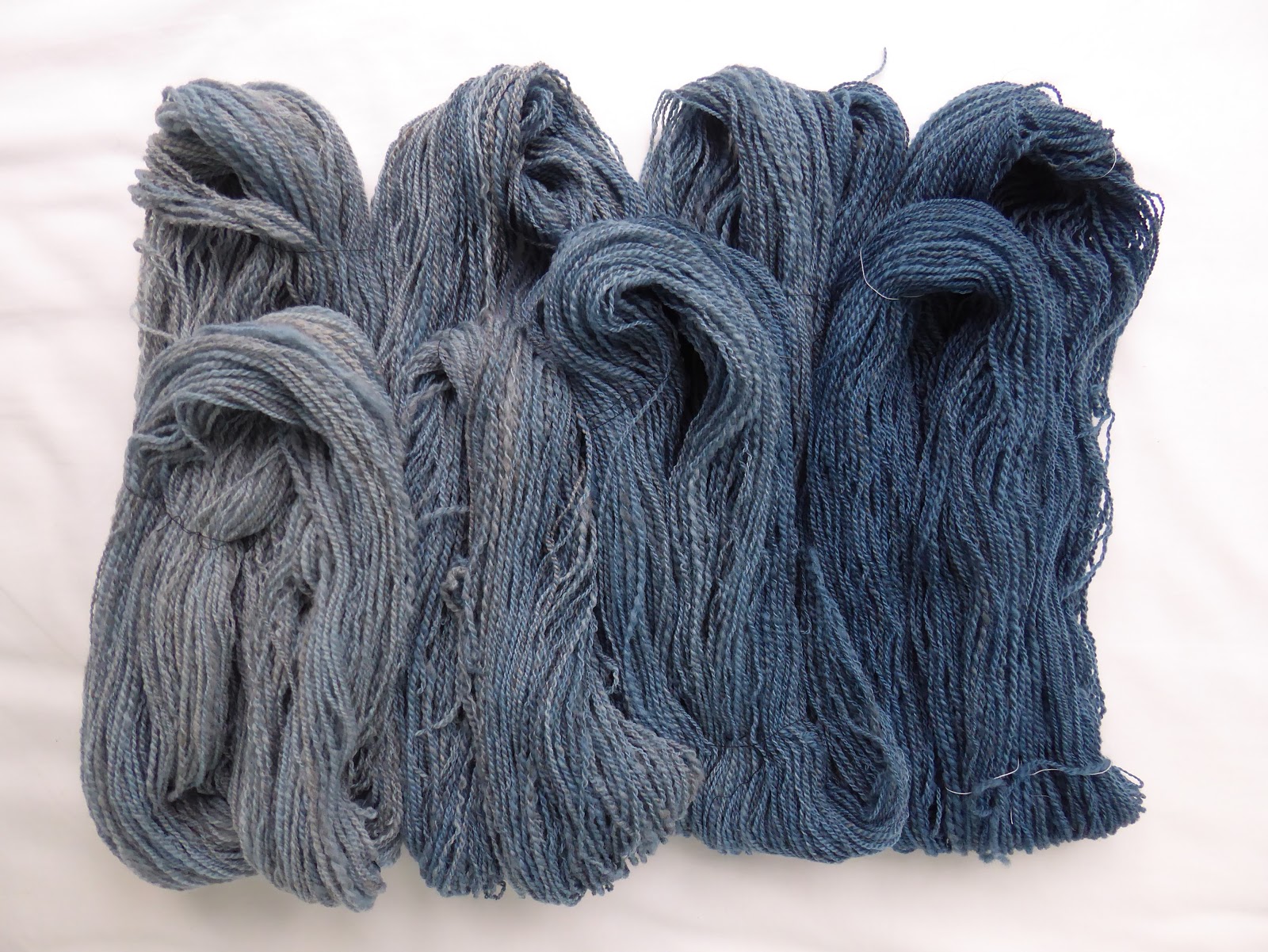
Here are eight 25g lengths of combed wool tops, after each piece had one five minute dip in a Japanese Indigo leaf dye vat. The wool is Captain Poldarles, a blend of white Polwarth and Merino D'Arles bought from John Arbon. The French Merino D'Arles is naturally coloured, so before dyeing, the tops were white streaked with soft shades of brown. Dyeing this gradient relied on the indigo leaf vat getting weaker each time a piece was dipped into it, so the depth of blue diminished with each successive piece. Further to that, you can see the indigo uptake from a single dip was uneven - it usually is, solid colour comes from repeated dips in the vat.  Doing several dips and rinses, in the past, I have managed to felt merino fibres beyond rescue.


A little gentle drafting returned these single dipped tops to a smooth alignment ready for spinning. Rather than bemoan a patchy dye result, I was of a mind to spin them into a yarn preserving the broad gradient and making a virtue of the added random colour variation. Commercial wool tops are often so processed the fibres lose all their crimp and become lifeless to spin. John Arbon produces tops with exceptional character which handle beautifully, retaining qualities typical of the sheep breeds. As I admired the tops and pondered on their destiny, I foolishly shared my thoughts with my companion, Elinor Gotland.


"This lush Polwarth and Merino blend is bound to lend itself to fine spinning."
"Fair play, Beaut, you've made more than enough chunky handspun."
"I think I will have a go at getting the yarn thickness down to light fingering weight."
Elinor grabbed my arm and marched me out to the hall.
"The finer the spinning, the higher the twist you'll need to put in. Time you took Sleeping Beauty for another ride."
I bought this Schacht Reeves spinning wheel from a friend about eighteen months ago, dreaming of spinning cashmere longdraw from the cloud with the huge wheel whizzing the flyer round at speeds that Roger, my Ashford Traveller could never reach, even if I pedalled his treadle like Laura Trott in the velodrome. In reality, since last summer's efforts produced an overspun, stringy yarn, the Schacht Reeves has remained an extravagantly ornamental fixture under the stairs. 


This time I spun on the lowest ratio, which was 14:1, aiming for two ply light fingering weight rather than three ply. I pulled each section of the tops in half and started with the palest, spinning that then the next palest onto the first bobbin, making a matching bobbin with the remaining halves and plying them together only just beyond the balance.

Though far from perfect, this yarn kept much more body than the last lot. Each of these four 50g skeins changes half way through from one shade of dyed tops to the next and within each shade there are darker and lighter stretches from the uneven dye and within each single, whatever the depth of blue, there is a greater or a lesser proportion of the overdyed natural brown merino fibres.


I sat glued to the computer screen for hours, scrolling through patterns and ignoring pointed remarks about when it might be time for tea and even the dog putting her head on my lap and drooling onto my jeans.
"I have to find just the right project. Light fingering weight yarn at last and I'm dying to see how this gradient knits up."
My companion looked over my shoulder while I was viewing a particularly lovely lace shawl.
"Find a pattern in stocking stitch.The colour of that wool is enough of a hodge podge, knit it into holes and frills and it'll look a right dog's dinner. Which one of us might appreciate, poor starving animal. Just look at those pleading eyes."
"But I like lace knitting and I've spun fine yarn specially."
"To be honest, Beaut, you've run out of people to give shawls to. Enough of the fancy work. Knit something plain that you actually need. And put the kettle on, do."


So I knitted a summer cardigan with three quarter length sleeves using this free pattern from DROPS. Elinor refused to allow me to do it with stripes, so I made each sleeve and the two front pieces staring with a different ball of yarn.


I did add in a little waist and shoulder shaping and a bit of extra width to stop the top button straining and will admit I am chuffed to bits with the fit. There wasn't quite enough indigo yarn left to finish the back, so I had to add in a few rows of off-white near the top. When I spun round to show the cardi off, Elinor was outraged to find I had also eked out the indigo at the bottom by including the off-white yarn in a Fair Isle wave pattern.
"Trust you to sacrifice purity for promiscuity. To add to your many style crimes, that outfit is practically double denim."


Friday, 4 August 2017

Hand Spinning Speckled Face Beulah Sheep Fleece

My companion, Elinor Gotland, caught me sighing over old photos of my friend Mary’s Speckled Face Beulah sheep.
"You're going to miss those Beulahs, Beaut."
“I am, and Mary, too."
"She's gone to a better place."
I bridled at that.
"It may be less rainy in France, but I wouldn't say it was better."
"You think sunshine and grape vines are less appealing than sodden fields and foot rot?"
"Even so, it must have been a real wrench to sell the flock after all these years. Don't they look lovely?"
“Fair play, the Beulahs are photogenic.”

I took this picture the January Mary first invited me to Ty Cribbwr Farm. Which is pronounced ‘Tee Cribboor’ - you’ll have to make what you can of Welsh place names when I tell you that for over a hundred years, Speckled Face Beulah sheep have been pure bred on the hills of Eppynt, Llanafan, Abergwesyn and Llanwrtyd Wells. Less hardy than the true Welsh Mountain sheep, which may spend all their lives out on high ground, Beulahs are bigger and comparatively manageable. Importantly for the farmer, they are excellent mothers. That day, the vet had come to scan Mary’s ewes. Many were carrying twins or triplets and though it pained me to mark their fleeces, my job was to paint spots on their backs to show which ones were going to need extra feed during pregnancy. 

Mary’s flock started when she was given a Beulah ram lamb triplet to bring on, because his mother couldn’t manage to feed three. He was nicknamed Boots, seeing as his legs were black to the knee and white above. The next year, she bought him a harem of ten Beulah ewes and by the time I met her, the flock had grown to more than a hundred sheep.

I did love lambing.
"There's a deep satisfaction, watching wet, new born lambs struggle to their hooves for the first time."
"And a hell of a struggle delivering the ones that get stuck at three in the morning. Alright for you, you only did the day shifts. It's all that free wool you'll really miss, Beaut."

True enough, waiting til summer for the shearing was a perfect agony of anticipation. The clippers buzzed, sweat beaded and bald ewes bounded away.  Beetling about, rather frenzied myself, skirting and wrapping the fresh fleeces, I had golden opportunities to compare and contrast fibres from several local breeds living on the farm. All Down types, the Beulah felt far, far less bristly than Welsh Mountain, though a Lleyn fleece just edged it as the softest wool in the pile. After skirting, the quality of wool and staple length across each whole fleece varied only modestly from an average of medium soft locks, about 10cm long, coarser and straighter over the breech.  Elsewhere, the crimp was tight, but disorganised, with a low lanolin content.  Not only resistant to felting in the wash, the clean locks were a pleasure to comb for spinning worsted and even the raw wool was light work to hand card for long draw spinning, which is my preferred method.

“I do love it when you can just get straight into a freshly shorn fleece and spin away with hardly any waste, Elinor. In my opinion, Beulah would be an ideal choice for a beginner. I had no trouble with any of the preparation and the fibres are good and grabby to spin.”
“No trouble with preparation? You rarely did any and you’re fooling no-one, you Slack Alice."
Last year was grievous, a spell of flooding kept the ewes on limited grazing for several weeks, which caused a weak point in the staple. This summer's shearling fleeces were excellent quality, I have just finished spinning one for the Tour de Fleece and am torn whether to snaffle just one more, before the woolsack goes to the Wool Board.

I did do proper sampling and studying, a few years ago when I brought home my first Beulah fleece. The wool was easy to manage and straightforward to spin, from high twist, worsted fingering weight to low twist, woollen chunky.  Pale cream rather than bright white, all types of yarn were much softer than I anticipated, being accustomed to Welsh hill breeds, which are best suited to making bags and rugs. As you would expect, given more time and effort, combed worsted yarn came out slicker and smoother, knitting up with a bit of a gleam and more drape. Minimal kemp meant no itchy ends were exposed by simply hand carding rolags from the whole locks and Beulah seemed at its best as a woollen yarn, full, bouncy and elastic, knitting up into a thoroughly cuddly fabric.

"Maybe Mary will wear that Beulah jumper I knitted, if it gets cool in the evenings, sitting on her French veranda. Maybe the meadowsweet dye will remind her of her damp Welsh valley."
Elinor looked at me.
"Meadowsweet loves it wet, but face it, Beaut, Mary doesn't."