While my friend Wrigglefingers was showing me how to spin coreless corespun yarn from a batt, she told me about Wolf Yarn. Much taken with the whole idea, I went googling about and read some contradictory stories. Though the details differ, it seems that Judith McKenzie invented it when she found herself in a tight spot and needed to spin fast, to keep the wolf from the door.
She spun Wolf Yarn straight from washed locks of wool, churning out sufficient quantities of conspicuously handspun single yarn to make unique blankets and jumpers which brought in enough cash to keep her going. Here is the woman herself, spinning and talking, you have to listen closely. Though it's not a slick, promotional video, there's enough there to make me long to go to one of her classes. She describes her yarn as a fluffy boucle, coreless corespun from a lustre longwool type fleece.
I think she says any locks over three and a half inches long with low crimp could be spun this way. Nothing lustrous in my fleece stash, but I have long owned a large Zwartbles off a farm in Swansea, proudly presented to me by my friend BG. Having struggled with a Zwartbles early in my spinning career, gratitude hid a shameful thought - Come friendly moths, fall on this wool! (It isn't nice and my cupboards are full.)
Though the staples are over 10cm long, the locks are rather more full bodied and bouncy than a longwool. I suppose there is plenty of disorganised crimp in a Zwartbles and that is my excuse for totally failing to get a boucle effect. I don't know how the twist in Wolf Yarn singles gets balanced. Maybe it doesn't need to be. I've heard you can weave with singles and I know that knitting garter stitch with a fresh single will share out the energy, so that the knitwear does not angle off sideways on the bias. Despite using a 5 to 1 ratio on the wheel, pedalling slowly and keeping the tension high to draw the single onto the bobbin fast, once taken off the niddy noddy, my skeins of singles just twisted themselves into a twirl. In the video, Judith specifically says her yarn is not felted, but mine got plenty of agitiation in two hot detergent washes and rinses, then several hot to cold plunges.

Felted single yarn doesn't spiral, mine hung thick, straight and stiff as old rope, utterly inelastic. What the hell, the plan for this deep brown stuff was to provide a dark foil for my colour fest singles, which I wanted to use in a rug. I intended to knit a semi-circle, constructed along the lines of a pi shawl, then add short row waves of colour, inspired by this shawl pattern. On the third attempt, after changing needle size and reducing to three increase stitches on alternate rows, I gave up trying to make the rug semi-circular and didn't bother to do any more stitch counting. Four garter stitch rows in brown separate short row sections of entirely random construction, turning when the colours in the mad skein shifted, attempting to pool some

shades and stretch out others while building shapes that seemed likely to interlock. Once I had used up one of the mad skeins and maybe half the Zwartbles, I cast off, stuck the whole thing through a wool wash cycle in the washing machine and gave thanks for the amazing plasticity of knitted fabric as I blocked the rug flat. I call this the Wriggle Rug. Loved it, knits up fast, I'll definitely do another.
 "Don't you think that was daring of me, freestyle knitting with no pattern?"
My companion, Elinor Gotland, has made friends with the puppy and now considers herself the Crocodile Dundee of Bridgend.
"Daring? Hardly. You are talking to an actress who has never relied on a stunt double."
Mental fuses blew, merely imagining a stunt ewe, never mind one with Elinor's unique physique. I started putting on my coat to go out for some fresh air.
"Wish I could get hold of Judith MacKenzie's book, The Intentional Spinner."
"You should write a book yourself, Beaut. Call it The Unintentional Knitter."
The dog noticed me picking up her lead and dashed in. Elinor fell off the doorstep, leaping for safety.
 I have been following the Wovember campaign - if you haven't seen it, do have a look, interesting articles have been posted through the month. Of course I wanted to join in with a wool along (WAL), so on the first of the month, I went rooting through my stash of fleeces, wondering how I ever bought so many and consoling myself that my home will be wonderfully well insulated this winter and I can go to bed knowing that hidden underneath me, several rare breed flocks are being supported.
The first fleece I bought in 2014 was an ordinary Blue Texel. Back in May, I posted about washing and skirting it and using the rougher fibres to hook a rug. I have been tripping over three bags full of unfinished project ever since. The bulk of the fleece had been sorted by colour, about a third of the wool had been spun, two skeins much thinner than intended, through talking too much on spinning camp in June. The final bag contained a start on knitting.
I'm very fond of rustic knitwear. Anyone going out in one of my jumpers walks in peril of being rounded up by a sheep dog. This bouncy fleece would be cosy, but on further consideration, spun into a bulky, woollen yarn and knitted into a thick jacket, it was all too easy to imagine the wearer disconcerted by an unexpected check for blowfly.
There are limits to my willingness to tempt fortune, but none to my love of dappled fleece colours. Blue Texel is full bodied with a disorganised crimp, which I think makes it a Down-type breed. The staple length varied from 3-7cm, though much longer once put on the hand carder, because the fibres are so elastic. No point fussing about neps in the rolag or twist in the singles, I decided the yarn's greatest quality was its natural grey/brown gradient and resolved to relax and take pleasure in quick, simple
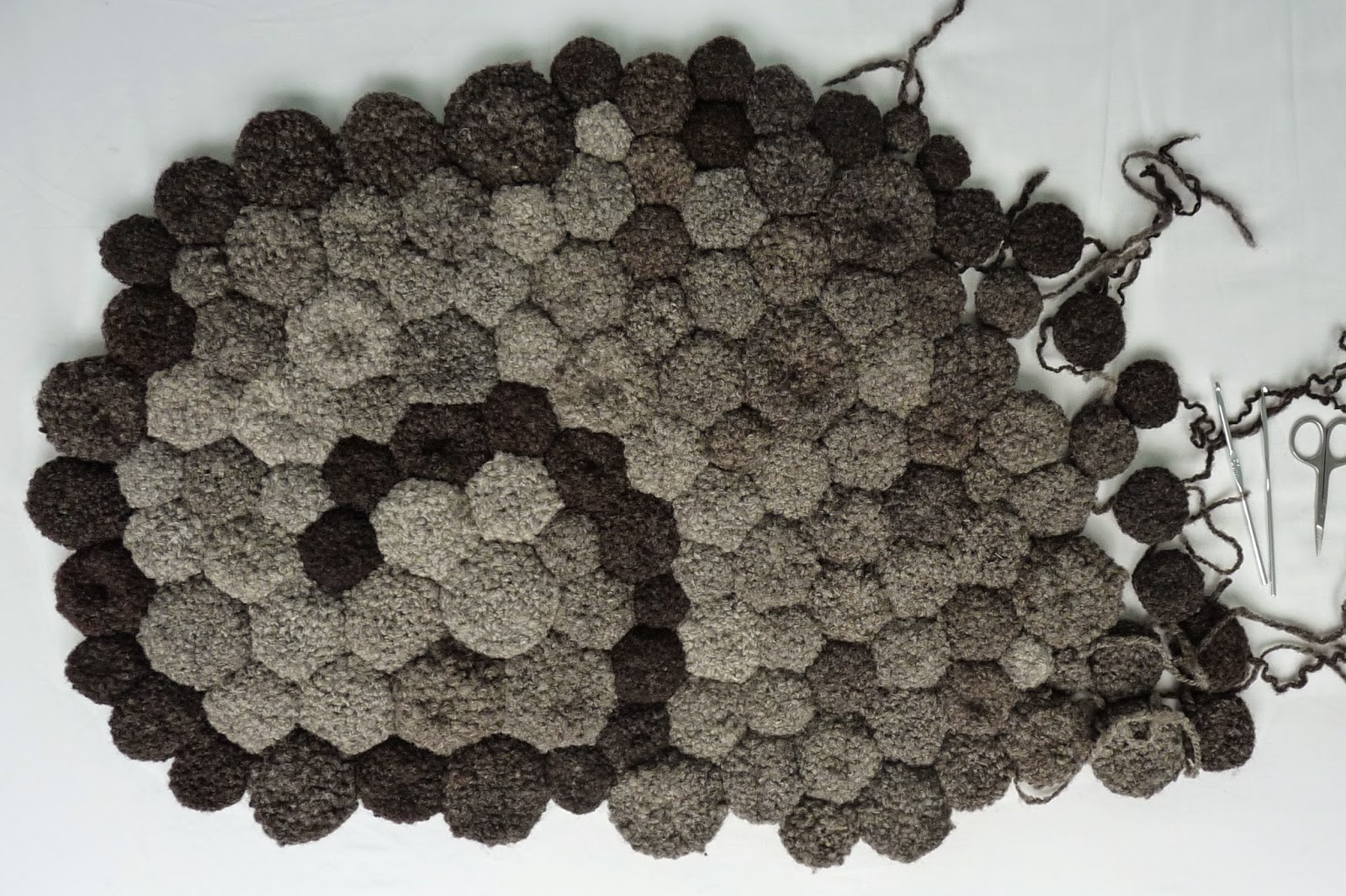
carding and headlong spinning as I pleased. A thick rug would make the most of the warmth and display all the shades. Double crochet creates a firm, tough fabric. Making a patchwork of little cushions should be comfortable underfoot and also meant there would be no need to strive for uniformity when spinning or to stress over the stitch count to crochet constant dimensions.
Each cushion started with a loop and two chain on a crochet hook between 4 and 5.5mm, depending on how chunky the skein of yarn. Six double crochet (US single crochet) stitches were made into the first stitch, bringing the yarn tail in to the centre. Continuing in the same direction, spiralling outwards with no special link at the end of the rounds, the
second round was two double crochet into each of the six stitches. Third round, one double crochet in first stitch, two in the next, one double crochet in the next two stitches, then two in the following stitch and repeat, then one double crochet followed by two double crochet in the twelfth stitch to complete. From the fourth round on, it all got a bit ad hoc,
 typically increasing in every fourth, then every sixth stitch with successive rounds, stopping when happy with the diameter. Filling the cavity loosely with a length of yarn, I reversed the pattern as best I could recall, decreasing instead of increasing till six stitches remained, breaking the yarn and threading it on a needle to sew the centre closed and bring the tail out through one side. Minimal stitch definition means no worries if you stray from the pattern, long as it looks about right.
By 15th November, I was more than half way through spinning the fleece, having unravelled the knitting and crocheted it up. It was a surprise to find each skein of 24 rolags only made between six to ten cushions. A fair sized hearth rug was not on the cards, although the original fleece had covered most of a floor in a modest sized room. I had planned a sort of pixellated image of an oak tree in autumn, but it looked unconvincing.
The Fibonacci spiral is a shape repeated over and over by plants and shells and even galaxies. This article says it has to do with the Golden Ratio of 1.6, though my maths isn't up to a proper comprehension of the numbers on Wikipedia. Copying it, approximately of course, this is how far I got by the WAL photo sumission date of 25 November.
Writing a sentence to send to Wovember about my experience of the project so far, my first thought was that it had taken far longer than expected to produce a much smaller mat. Right behind that idea came a terrible tendency to wax lyrical and as usual, I sploshed right in, getting out a book of Gerald Manley Hopkins poetry, which I find should have been returned to the school library in 1980. Ah well, only two people had taken it out since 1975 and through the marvels of the interweb, now anyone can have a read of Pied Beauty. I name this rug Dappled Thing and rejoice in its landscape, plotted and pieced.
From the sublime to the fastidious. Here it is in action.
One fleece transformed into two matching bathroom mats. Harmonious cushions, if not quite the music of the spheres.
M&S make machine washable 100% wool jumpers, but it is possible to felt them. The grey green one in the picture had shrunk from its original 42" chest. The red one had oil stains on the collar, so I put it through a cottons hot wash on purpose. The multicoloured one from a charity shop completed my collection. Another fascinating display at Wonderwool showed a technique called standing wool, used by Rosemary Stowe and Gill Curwen to make rugs and mats.

Gill's big rugs are fabulous, but I got these jumpers to make a table mat, as practice. Cutting the front panel of each jumper into strips, the edges frayed a little despite the felting and keeping a straight edge is not so easy when clothes have warped over time to fit their wearers. Double width strips can be folded over so the visible edge has no loose ends and accurate cutting is less critical. Starting with a strip of each fabric folded in half along its length, I rolled them up together like a Chelsea bun, leaving long ends attached, then stitched across the diameter of the circle, going round like a cartwheel, to hold the roll together.

It takes a long needle to push through the width of a single roll, longer still to sew two rolls together. I used a long darner and linen thread for strength. Starting off, I was aiming for symmetry and matching rolls in the three combinations. As the result was uneven looking and increasingly awkward to work with, I switched to making individual rolls with whatever strips came to hand.
These rolls used up the fronts of all three jumpers. They got sewn on to the central piece wherever they fitted, some just as they were, others with the loose lengths wrapped around their outsides. I thought this would help hold it all together and give the random design a bit of coherence. The finished mat is fine flat on the table, though it splays apart between the individual rolls if you pick it up by the edge. Tighter rolling and firmer stitching next time.
Just for once, Elinor Gotland approved.
"Firm and supportive, this, Beaut. It'd make a lovely yoga mat."
"You do yoga? Evening classes, is it?" My incredulity must have shown.
"I'll have you know I was taught by the Mumbai Guruji. The movie business out there is all chalo, chalo and no time for chai, Memsahib. Us Bollywood actors were glad of a bit of pranayama to fall back on."
Elinor was up unusually early next day. Coming out with my cup of tea, I found she had taken the mat outside and was in the Hatha Yoga Asana 'Standing Wool'. I won't say she was only scoring a point, because no-one could balance on one hoof for that long without a lot of practice. I slurped tea noisily, Elinor remained poised.
I suspect neither of us were that sorry when it came on to rain.
"Oooh, best not let your lovely mat get wet, Beaut!"
Back in the house, I conceded defeat.
"That guru wasn't wasting his time with you! Do tell, what Bollywood films have you been in?"
"You might have heard of 'How Shanti was my Valley'. Made that with Amitabh 'The Man who put the Ram in Ramayana' - total superstar in India. Still, it was my wet sari scene that got all the publicity. Film was barely out of production before we started on 'How Green was my Karma.' but I never finished that one."
"Didn't you want to stay?"
"Course I did. Cracking people, lovely food. Problem was one Bombay Mix too many. What with that and the monsoon season, I got struck. Nothing for it but the first plane home. Fly strike can be fatal, you know, Beaut." Elinor exhaled gustily. I left her in peace to open her bottom chakra.
This is the raw fleece of a Blue Texel sheep. Although unwashed, it had very little dried grass in it and had been cleared of all matted dirt - in short, no sheep shit. Thanks to this, most of the tail wool is missing, but it was easy to tell the tail end, on the right of the picture, because the locks were so much coarser and full of hairy kemp fibres.
I bought it chiefly for the colours. The blanket, or underside of the fleece, which was close to the sheep's skin when shearing was done, shows the dominant colour of the wool, which is grey. This photo shows the rolled up fleece. From the photo above, you can see how dark, chocolate black edges shorn from the belly and legs shade through browner greys to reach pale grey along the top of the sheep's back.
The fleece is big, at least 3kg, plenty for a couple of projects. I pulled off all the coarse locks from the back end, or britch and all the more matted and short staples from round the edges. Much of it seemed too rough to spin for clothing, so I ended up with a big pillowcase full of skirtings. Washing raw fleece to remove dirt, lanolin and grease is a science in itself. Many fine wools felt easily, but I guessed this particular Texel might survive a 40 degree centigrade wool cycle in the washing machine.
Elinor Gotland was scandalised.
"Don't play fast and loose with your assets, Beaut. You won't be told, but they knew how to wash fleece properly where I grew up. It needs a long soak and no agitation."
Sheep can sustain a very long, hard stare.
Well, I admit I have been guilty of banging on her bathroom door. At least now I understand why she always takes so long getting ready to go out. After Elinor had read me the riot act, I secured the pillow case with safety pins, put a huge squirt of washing up liquid in the powder compartment and those coarse Texel skirtings came out of the wash beautifully clean and not felted at all. So there.
Among the many delights of Wonderwool was a visit to Rag Art Studios. BG and I got a demonstration of hooking fleece through hessian to make rugs. I treated myself to a rug hook and a couple of metres of best quality hessian. Although I had seen the basic technique, I made the rest of this up as I went along. First, I used a dustbin lid to draw a circle on the hessian and used it as a guide to cutting out an approximate oval. In my experience, avoiding geometrical accuracy from the very start means you can call a design 'organic' rather than getting fraught when it doesn't come out symmetrical.

I drew on a freehand pattern, leaving a margin of a couple of centimetres. Folding the edge of the hessian over to the front, I hooked around the edge through the double layer. This was slow going, although it did hem the hessian. The fabric will flex easily enough for curves, but I should have left a wider margin as the coarse threads fray easily. There may well be a better way of getting a strong margin for a rug.
 I had sorted the Blue Texel into four broad categories of colour. The darker locks, being from the belly, had shorter staples, some only 5cm long. They were much less easy to pull out by hand into some form of continuous roving and needed more twist than the longer grey locks. Once I had hooked in the outline, I filled in each section. I think I could have left more space between each bump of fleece, as the final rug is very dense. Although it tried to curl up at the edges, once the whole thing was done, it laid flat, because the curl downwards is counteracted by the weight of the rug on the floor.
 Having imagined that the fat bumps of thick roving would fill out a big area pretty quickly, I was surprised how little progress I made each evening. Still, rug hooking is a satisfying process. This is how I did it.
 Working from the back of the rug, put a bit of twist into a short section of roving. Turning to the front, push the sharp point of the rug hook through one of the holes in the hessian. As the hook comes out at the back, catch the twisted
 roving under it. Pull the hook back through, bringing a loop of roving to the the front. And repeat, repeat, repeat ...
This small rug used almost all the skirted fleece. It measures roughly 49cm x 56cm and weighs 450g. Expensive craft, if you paid for beautiful, soft, dyed roving just to make a rug, but a great way of using fibre that would otherwise go on the compost heap. The name of this one is 'The Chicken Or The Egg?'. It is now a bathroom mat, very warm under foot and probably machine washable, too.


 "Don't you think that was daring of me, freestyle knitting with no pattern?"