Friday, 10 January 2014

Dyeing Wool and Alpaca with Mahonia Berries


A box of frozen mahonia berries has been lurking in the bottom drawer of my freezer, thanks to an autumn trading session with dyers on Ravelry.  The berries are reputed to give a purple dye, though I have been warned, more likely grey. Not a problem, I love grey, it's a very flattering colour.

Here's a photo of a mahonia bush, growing just down the road from me.  I noticed it because the bright yellow flowers have been dazzling against a dark green clump of holly.   I believe the berries ripen in autumn, certainly none there now. Wild, wet and windy last weekend, I had a snotty cold, was fed up with work and not looking forward to dismantling the Christmas decorations.  The house always looks so bleak without them, no more fairy lights dispelling the gloom of the long dark nights. A new dye project cheered up my packing away and cleaning.  I've not previously dyed anything with frozen material nor tried using any part of a Mahonia bush, so quite exciting stuff.  Plus, I wasn't just dyeing wool.
Among my many blessings, reasons to be cheerful and not a miserable old cow, is this fabulous box of alpaca.  Last summer, I entered a couple of patterns in a TOFT design competition for using up small amounts of yarn.  One was judged a runner up and this prize arrived just before Christmas - two kinds of alpaca fleece and a ball of alpaca yarn blended with silk.  So fine and soft and light. Alpaca is surely destined for lace knitting.  
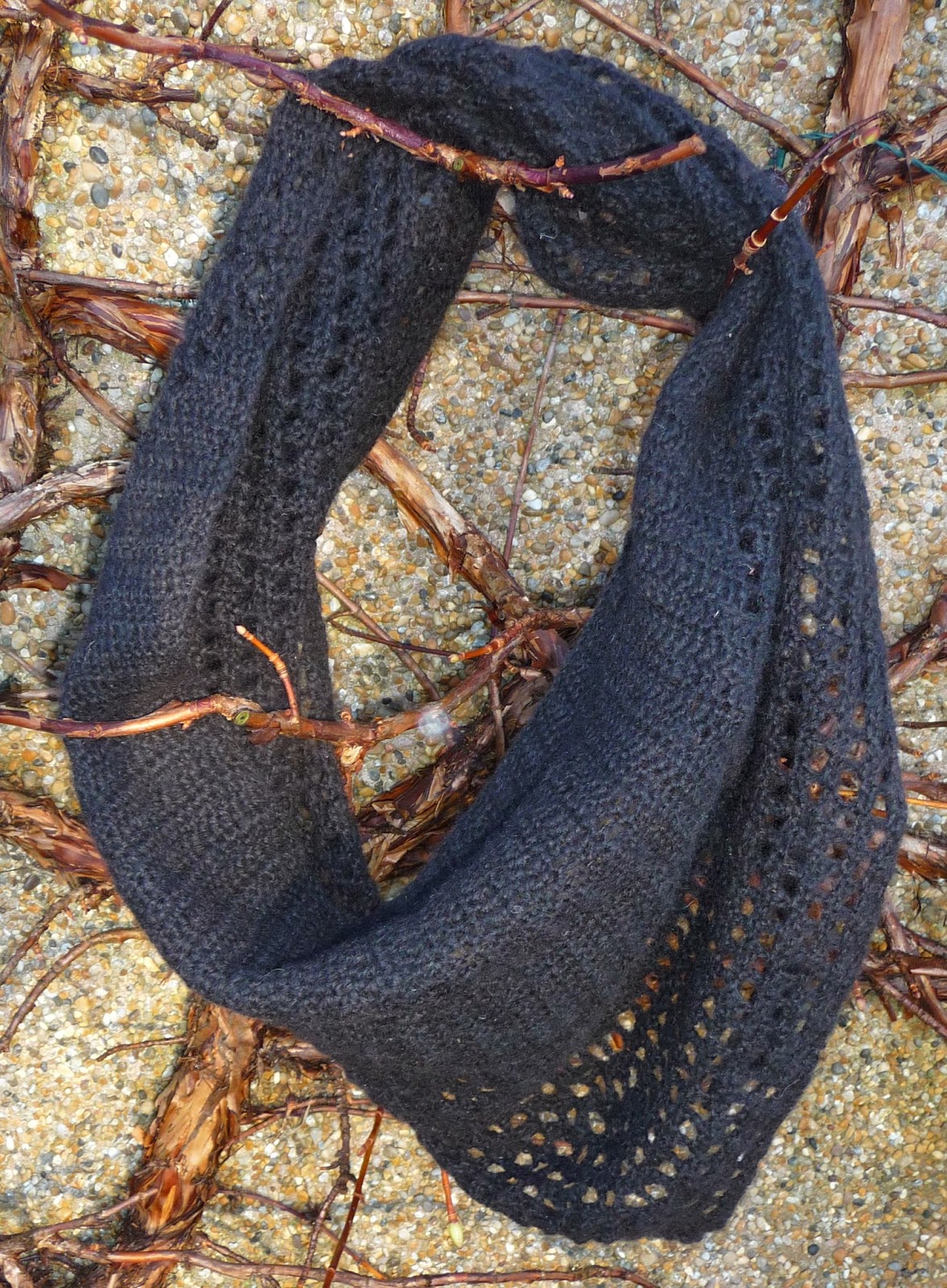
The 50g ball is 230m long.  Searching lace knitwear, I found ete chic, a French pattern for a narrow summer scarf which required only 175m yarn.  Perfect, the lace band is only 12 stitches wide with an eight row repeat.  How far wrong could anyone go?

The brutal truth is that I am not destined to knit lace. At least half of the repeats in this band had to be unravelled.  It is a very good job that the end of each repeat is clearly defined by two cast off stitches.  If I had had to go back to the beginning every time I got it wrong, I'd be at it still.  Some of the yarn in this lace band ended up seriously mutilated, grey and sweaty.

The body of the scarf is plain sailing, garter stitch is surprisingly pretty in a fine yarn.  It really did only need 175m, so I still have some of my ball left over. When TOFT announce their competition results, I'll be looking to see how much yarn the winning project needs.  Til then, lacework can wait for bright sunshine to improve my temper and the visibility of fine twisted stitching.

The mahonia berries weighed 200g.  Jenny Dean's book, Wild Colour suggests an equal weight of fibre to berries.  Hoping for a deep purple/dark grey, I only used 100g fibre - the 40g alpaca scarf and two skeins of handspun wool, weighing 50g and 10g.  I washed the alpaca gently and scoured the wool vigorously then mordanted the lot with 10g alum. This was to be a one stop dye bath, extracting the dye from the berries at the same time as dyeing the fibre.  Wild Colour recommends simmering mahonia berries for 45 minutes maximum.  I poured all the berries into the water with the fibre and started to heat it up slowly.  No colour seemed to be showing when I peered at it.  Damn - forgot to crush the berries!   Not a problem, they were floating on the surface, swollen up like sultanas in brandy.  Great fun to squish, they popped like bubble wrap and obligingly sank down out of sight.  Lots of orangey colour started to swirl out, but a dye bath often looks different to the colour the fibre takes on.  In between carting boxes back up to the loft, frequent visits to check progress meant I kept the temperature almost exactly 90 degrees centigrade for precisely 40 minutes before turning off the heat and leaving the lot to soak overnight.


Oaths and imprecations unsuitable for a Sunday morning. Yet again, I have created beige. The wool has gone a warmer colour than the alpaca/silk mix, which is interesting to know, but hardly substitutes for even a temporary purple result.  Not so much as a lavender tint.  

Gutted.  


Right, try soaking the little skein in a soda ash alkali after bath, see if it goes a soft green, like the book says. It did go greenish, but frankly, the contents of my hanky are more appetising. 

Some weekends, the nicest thing that happens is discovering a forgotten Toblerone while wiping down a bookshelf.


I've saved a few seeds from the frozen berries and put them in a pot of earth outside.  If any germinate, I'll have a handsome winter flowering plant.


Friday, 3 January 2014

Hand Spinning a Hebridean Sheep Fleece

This is UK 110131 00076.  She is a Hebridean ewe hogg, which, I think, means she was a lamb in 2012.  Her first shearing was on 31 May 2013.  She looks mutinous in the photo, courtesy of the seller, scocha. This small sheep's fleece arrived clean, open and well skirted.  I was delighted at how silky it was to handle, having read that Hebridean fleece is durable - euphemism for harsh.  
Feast your eyes on this dark wool with gingery highlights.  Each staple was long and tapering, with a softer undercoat.  The lustre and depth of colour is gorgeous. Little white hairs of kemp were scattered throughout.  Carding rolags from the raw fleece was easy work, since there was no matting in the blanket and the moderate lanolin just held the fibres together nicely.  
I did have a go at combing to separate out the longer fibres.  The photo shows how the shorter ones just got knotted up in the process.  I don't know how they could be salvaged for spinning.  My intention was to spin about fingering weight, which proved quite possible working from rolags, since I don't mind the yarn being a little uneven.  I just remind myself that people go on courses to learn to make art yarn.  
This Hebridean became what I consider a poetry yarn.  Prepare for a bout of bastardised Byron.  

UK 110131 00076 walks in beauty, like the night, 
And all that's best of dark and bright 
Meets in her fleece and in her wool, 
Thus mellowed to that tender light 
It spins up something wonderful.


I came over all lyrical about the colour, lovingly picking out the odd white hair of kemp. Spinning with medium twist and plying loosely, I decided the yarn was soft enough for skin contact. I chose what I think is a cracking men's scarf pattern to make for my firstborn.  It is called Mister X, by a German designer who has put an English version of her pattern on Ravelry.  The family burst my balloon, as is their wont. Crocheting away during a preChristmas get together with my sister's family, I expected them to marvel at my yarn.  Not 'Oh, you're making a brown scarf now, are you?'  In vain did I point out the nameless grace Which waves in every raven tress.


I got another reality check on Boxing Day when my son broke it to me gently that a bloke wearing this scarf would not make it to the bus station in our small town.  Did I want my tiny darling to come home with teeth missing?   Could he not have socks instead?  Hey ho, my alien roots are showing again.  Coming from England, with brothers who will slip into a frock faster than you can say 'fancy dress party', has evidently warped my perception of what passes for manly attire in Wales.  I still consider it one of the best things I have made.  

The remainder of the fleece was spun about double knitting weight and made into a Butterfly Wedding Cowl, which I will keep for myself and sod them all. Hebridean fleece isn't as smooshy soft as Polwarth. It is sturdy and a pleasure to handle.  Maybe it takes a spinner to appreciate it's finer qualities.  Good job I have a tough hide and eyes to see the tints that glowed in UK 110131 00076.  

Far too good for socks.


Friday, 27 December 2013

Knitting Socks

'Socks for Christmas' sounds more like a threat than a promise. Hand knitted pairs spread the love better than a multipack of sports socks, but even so .... they look misshapen. This is not because the knitter was at home to Mrs Cock Up. Custom made woolen socks fit in a way that elasticated tubes simply don't.
These are Hollyhock Socks, stripes knitted with the small skeins of double knitting wool I dyed with hollyhock flowers last summer.  I gave them to my daughter for her eighteenth birthday - only as part of her present, I'm not completely deluded about how marvellous they are.  

I made a right performance of knitting gloves and long ago gave up trying to manage anything suitable for the human hand.  In magazines, sock patterns with fabulous cables and lacework have me sighing and turning the page.  For me, turning the heel, shaping gussets for the instep and grafting the toes guaranteed I'd get stuck and end up stuffing the ufo to the bottom of the stash, a thorn in my side forever.

Then I came across this phototutorial by Sally in Wales on Downsizer.  The title 'Socks Demystified' was most encouraging.  Unlike so many others, the pattern is for aran or chunky wool.  Thanks to the photos and explanation, at last, I understood the grand scheme of sock anatomy.  I managed to complete a pair of socks for my husband, using Suffolk Fleece dyed with yarrow. He wears them often. Substantial and successful.  Notice the special stitch for the heels to take hard wear in boots   Most satisfying.

The Hollyhock socks were made following a very similar pattern for double knitting wool. I found using double knitting wool took a great deal longer to make a sock, but then, I am fairly new to double pointed needles.  I imagine it would be a massive undertaking to knit a pair in 'sock wool', which looks about fingering weight.  The pattern is free here, also has helpful guidance for beginners, including step by step instructions for grafting the toes with Kitchener stitch.  The website invites you to donate to Medecins sans Frontiers, which is a timely suggestion, after the funeral this week of the British doctor who tried to help the sick in Syria.  

Steve's socks impressed my sister, who suggested I make a really thick pair for her partner, who will wander round the house in stockinged feet.  Welsh Mountain fleece is durable stuff, should take a battering.  I had some left after making a jumper, so I dyed part of it with coreopsis plants.  These are annuals and had flowered til November, but were on their last legs.  I read that the whole plant gives dye, not just the flowers.  It seemed a shame not to wring every last drop out of them when clearing the border.  While the colour is not the rich orange of summer flowers, this golden bronze from stems and leaves was not half bad.   Fun to spin chunky and a really quick result, as I reduced to 30 stitches cast on. Wrapped up with the latest Uhtred book from Bernard Cornwell, that was one Christmas present sorted.


My latest sock offering has taken forever to complete. Serious knitting in the run up to Christmas.  Steve has had to volunteer for the risky 'sock of death' manoeuvre - still not long enough?  No, it is not a trick of the light, the socks are slightly different colours.  One is made of wool dyed with bracken tops picked later in the summer than the other. Happily, my youngest brother habitually wears odd socks and would actually feel uneasy in an identical pair.  I am pleased that neither skein has faded after six months or so in the wool basket.  Making a very concentrated bath has given better dye fastness than I got last year.  The green is bracken overdyed with woad.


Socks for Christmas.  Perhaps I should have put a satsuma and chocolate coins down the toe end.

Friday, 20 December 2013

The Knitted Work Bag Fiasco


My friend BG prefers to be surrounded by saucers with dried up blobs of paint and half empty glasses from which she accidentally swigs turpentine. Things do not go wrong in her projects, they just develop in unexpected directions.  Mostly toward a distinctively BG style of uncanny beauty.


I prefer to feel organised, but my knitting patterns don't always work out as intended.  I struggle to regard such accidents as 'happy'.  BG's Christmas present was meant to be a tote bag with a draw string top, to keep her craft stuff safe when she comes round to my house.  I have rarely known her go out without at least three bags, all of them inadequate and one near to bursting.  The work bag wasn't a bad idea, it just turned out to be one of those projects plagued from first to last.

First, the wool was dyed with weld, a trusty source of bright yellow.  Lovely.  Then I dabbled in the less predictable alchemy of woad.  Overdyeing did not give the deep shade of Lincoln Green I intended.  Over optimistic about the amount of woad in the available leaves, I ended up with paler greens and yellows. Well, it still looked ok.  Unfortunately, the skeins were hung up to dry next to some other wool dyed with coreopsis.  The wind blew them all into a tangle and random orange stains leaked into the green.  Bugger.
Knitting a square base seemed like a good start.  Making some increases in the middle of the straight edges was supposed to make it more capacious and rounded, but actually came out awkward.  Hey ho, too late to frog it, I've still got socks to finish before the festivities.  Not to mention purging the fragrance of old dog from the sitting room before guests arrive.  
Knitted furiously round and round on a long car journey, the bag came out too short, even though I used up every scrap of dyed wool.   Chunky yarn on 4.5mm needles does give a good firm fabric, only less of it than I expected. 
The final straw - I found the drawstring wouldn't close the top properly.  That firm fabric does not scrunch up much.  Right - to the washing machine. Time for the old 'Reshape while damp'. 

Like Alexander Fleming's laboratory assistant, peering at the mould killing off the bacterial colony in his petri dish, I think the result could be A Good Thing After All. 
I shall present BG with the last word in needlefelter storage baskets for bits of fleece and scrap yarn.  At least she can see what is in it without emptying the lot onto the floor. It will be called 'Who Left the Lid Off?'


The pattern can stay on the back of an envelope.  If I manage not to lose it, this trial and error might come in handy for some future design.  

In the meantime, it makes a homely nest for a needlefelted bird.

Friday, 13 December 2013

Making Needlefelted Flower Brooches and Hats

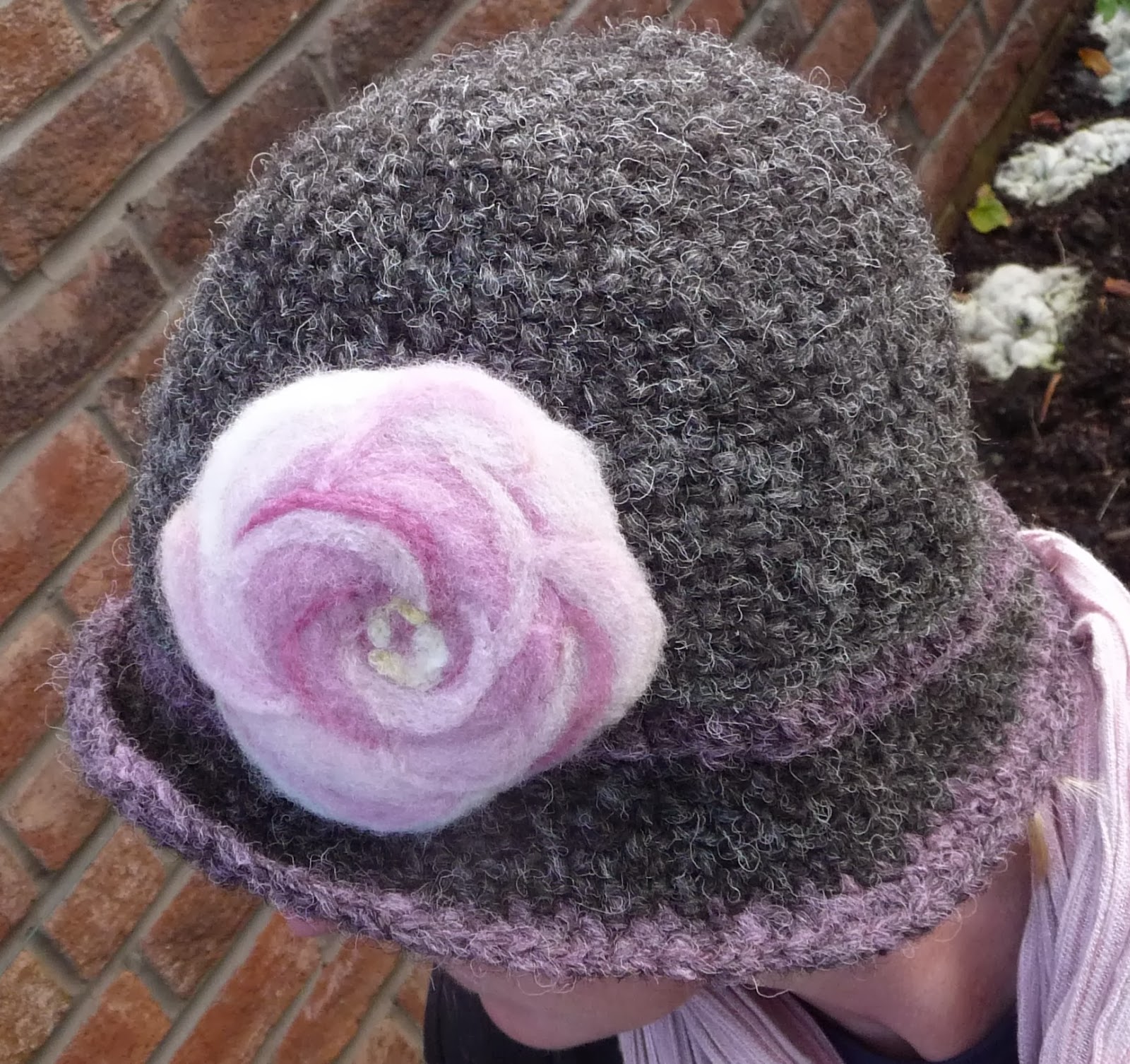
I recently discovered that Dorset Poll fleece needlefelts quickly into an open, bouncy fabric. Having made a brooch for a Herdwick hat,  I needlefelted another flower directly onto a bag I crocheted with the rest of the fleece. 
Herdwick yarn does not try to felt together when you scour a skein.  I put a small crocheted piece through a 95 degree centigrade wash cycle with some old towels and it barely shrank at all.  If this hat got dirty, it could go through the wash with no trouble, as long as the brooch was unpinned first.  It is good to know which fibres won't pill or felt with hard wear.  I've had a go at needlefelting with Herdwick and find it will mat up quite readily into a very open, hairy brooch.


Needlefelting the Dorset Poll gives a full bodied, but smoother effect.  After kind encouragement when I showed off the hat on Ravelry, I decided to blog about how I made the flowers. Inspiration for the general idea was a picture of a peony.  The needle and brooch back are from Adelaide Walker, roving was combed from the back end of my Dorset Poll fleece dyed with lichen. Felting onto the curved surface of a child's sponge football means the finished brooch has a three dimensional bulge, which works well for a blowsy blossom.


First,  stab the needle through the tail end of a darker shade of roving, curl the roving round, not aiming for a perfect circle, felting it on lightly.  Overlap slightly with an outer band in a lighter shade of roving, needlefelting round until you have the size you want for your brooch. Peel it off the sponge ball before it gets too stuck and needlefelt from the opposite side to firm it up.
Turn it back to face you.
Add shorter segments of pale roving over the top, a bit like the petals in the picture, then add darker curves like the shadows.


Attach the brooch back by felting a short stretch of roving first through the three holes in the bar, then along its sides. Finish by felting on stamens.


It occurred to me that I could make a hat by felting a whole half of the football.  A basic skullcap crocheted in yarn from the same fleece was stretched over the ball as a base.


Then roving was felted over the top in much the same way as the brooches.  I got a bit carried away with doing swirly 'petals'.  What started as a simple, if very pink, winter hat, turned into a madly exotic peony.   
My sister Pip is probably the only person who would wear this, so I gave it to her straightaway.  It actually works, if a bit liable to fall off.

The more pedestrian stuff is getting packed up for Christmas.


Friday, 6 December 2013

Hand Spinning and Dyeing Herdwick Sheep Fleece

This is not just any Herdwick sheep, this is UK564083 00014. She is a two crop ewe, (three years old) and had two lambs on 10 May 2013.  On 14 May she was shorn and on 24 October, I bought her fleece for £4.
It arrived in a box, carefully rolled so it was easy to lay back out again.
Fully skirted, hardly a twig or seed left in her wool, the locks were open with no matting, all the greys from almost black to practically white.   I have never received such a beautifully presented fleece, let alone had the opportunity to pick one from a selection of photos or been given details about the sheep themselves.  If you would like to buy a Herdwick fleece, I recommend you contact scocha on Ravelry.  She keeps other breeds too.  The photo above is shown with her permission.


The long fibres are crisp and wavy, rather than tightly crimped, with a shorter, finer layer at the base.  Though this sheep lived in Scotland, the breed originated in the Lake District. I had read that Herdwick sheds water more efficiently than other fleece and can confirm that scoured skeins dry out in no time.  What a good strategy for a rainy climate - instead of producing oils to waterproof their wool, Herdwicks simply don't get wet. Visions of UK564083 00014 tossing aside an umbrella and giving it a bit of the old Gene Kelly - Singin' in the Rain.  Anthropomorphism?  Beatrix Potter, eat your heart out.


Combing the locks did not go well. The undercoat got separated out with other shorter fibres, but drafting roving off the comb was frustrating.  The fibres did not want to drag a continuous flow behind them, so I kept getting handfuls of one staple length.  


Carding makes a bouncy rolag. Using high twist, it is quite feasible to woolen spin a fingering weight yarn. 

Being such clean, dry open locks, spinning from the fold was a delight.  First time I have been able to spin without so much as flicking tips with the dog brush. No preparation was needed before spinning an 'artistic' aran or chunky wool - what a pleasure to work straight from the fleece! All credit to scocha, who clearly knows what a spinner values.


I divided the wool into darker and lighter halves.  As the top photo shows, darker locks came from the chest and shoulders and the dark yarn proved softer.  I've done very little dying on naturally sheep coloured wool, which is lovely anyway. However, I did wonder what the effect might be on the lighter yarn.  I had just fermented the lichen I collected after the October storms.

Since the dye was ready to use, I brewed up a vat for a couple of the paler skeins.  The picture above shows the three colours and weights of yarn I had to choose from.

A good looking hat was featured in this month's Purl Two Together news.  This struck me as the perfect purpose for wool that doesn't get wet.  Better still, the Novi Hat pattern by LThingies is free.  I used the softer, darker wool spun about aran weight, coming down to a 4mm hook to get the right tension. The needlefelted brooch is made with Dorset Poll fleece from the same dyebath, so you can compare how the grey fibres sadden the colour relative to the effect on white fleece. Some comparisons are odious.  There will be no comments about the wool looking better on the sheep.