Showing posts with label Yarn. Show all posts

Friday, 1 March 2019

Belt and Braces Knitted Bag Construction

Like the daffodils, already flowering in this unseasonably warm February, my companion, Elinor Gotland, has decided Spring is upon us. Fuelled by a couple of episodes of Marie Kondo, the Spring Cleaning Urge has galvanised her into radical action and none of my wardrobe is safe.
"Is that battered old cardigan really 'sparking joy' for you, Beaut?"
I picked at a sleeve.
"Well, I don't feel joyful about the felting and pilling on the cuffs, but I am really fond of this one."
Elinor was not so easily to be thwarted. She intends to take a full bag of my clothes to the charity shop.
"Consider, would you dream of wearing that cardigan outside the home or are you just wasting cupboard space on an item of limited function for foolish nostalgia?"  
I hugged my droopy knitwear round me.
"This is precious. And vintage. I remember buying the yarn in the 1990's at Liberty's and it cost me an absolute fortune. Back in the day, I'd never seen knitting wool like it, quite irresistibly gorgeous. I think the yarn must have been Noro and I think maybe it can still be salvaged."

Once the collar and cuffs had been cut away, the body of the cardigan unravelled quite readily into about 450g of aran single ply yarn, looking like a loose blend of wool and silk in a long colour change. 
My companion positively snarled when she caught me heading upstairs to tuck it away in my yarn stash.
"Surely storing a cardigan as balls of wool must be a step up on folding your Tee shirts really small?" 
Elinor dragged the charity bag into the hall.
"Use it or lose it, Beaut."

With plant dye baths, I find it jolly difficult to achieve slow transitions of dye on yarn. A vague idea of using a long colour change to knit entrelac, as suggested in Margaret Radcliffe's book, The Essential Guide to Colour Knitting Techniques, has been on the back burner of my mind for some years. On a wet Saturday afternoon, I took the book off the shelf and read through the instructions.
"Looks a bit fiddly to do. Have you ever tried this, Elinor?"
My companion was bolt upright on the sofa, transfixed by the rugby. She turned to me as they reset the scrum.
"Entrelac is my middle name. Get a backbone, you'll be fine."
Casting on 60 stitches on 4mm needles, I followed the instructions to create six 10 stitch base triangles and spent happy hours rapt in the pleasure of seeing what colour would appear next and how it would play with the adjacent sections. Entrelac is satisfyingly interesting knitting, holding my attention just enough, but not too much to critically appraise controversial decisions in several successive Six Nations Rugby games. 
"Referee! Knock on!" 
My companion bounced on the sofa as George North charged up the field. 
Like the French team, I'd have done better to start with a game plan and stick to it. When more than half the yarn was used up, I still had no idea what to do with my piece of entrelac fabric, 52cm wide and now 45cm long. Time to finish with a top row of triangles.


Folding it in half, crocheting the long edges together and tucking in the corners to create a squat, oblong box shape, I decided that with a wide brim on top, the piece could become a bag. Casting on 20 provisional stitches and knitting a strip in stocking stitch, when it was just a little shorter than the total distance around the top of the bag, I joined the two ends with a three needle bind off.


"I doubt you washed that cardigan very often." My companion watched the dirty water swirl away after the two knitted pieces had had a thorough scrub. I heaved a sigh as I laid them out flat to dry.
"The strip for the brim has curled up and though I hoped hot water would tighten up the entrelac, it seems to have got looser. Hey ho, lining the bag with some of Mum's leftover upholstery material might firm up the construction."
"What about folding some of this jute upholstery webbing inside the brim piece? That'll uncurl your knitted strip."
Two inch herringbone webbing fitted perfectly inside the folded circle of knitting I'd made for the brim, forming a stiff belt from which to suspend the entrelac bag. To give the bag shape, I sewed another length of webbing against the seams on the short sides and tacked it to every junction of entrelac squares across the base, folding each end of the strip over the belt for the brim.
A third length travelled up from under the base webbing, crossing outside the brim, looping over to form a handle, passing back down under the base and coming up on the other side to loop over as the second handle and finishing under the base. Wherever they touched, the strips of webbing were sewn against each other, except where the handles crossed the brim.
It took an unconscionable number of pins to hold the lining against the brim, the brim against the top of the entrelac and the knitted strip over the brim, but once everything was in place, a single circuit of running stitch sewn with button thread through the lower edge of the brim webbing held all these elements securely together. Next day, I was due to travel up to Edinburgh to visit my daughter. Desperate to find a project to keep me entertained on the journey, my companion watched me scuffle about, madly rejecting patterns and casting aside unsuitable skeins of yarn.
"Calm down, Beaut. Why not take the entrelac bag with you as hand luggage and use up the last of your recycled yarn knitting covers for the handles while you're away? You could even use the buttons off the old cardigan to reinforce the handles flat against the brim."
Sounds improbable, but this plan worked perfectly well.
When crocheted inside a ten stitch wide strip of knitting, the webbing didn't so much roll as crumple into a tube shape, but the handles are both sturdy and comfortable to hold. I even had enough time and yarn to knit pockets for inside to hold my purse and phone. 
This could become my basic construction method for all sorts of knitted bags, upholstery webbing making them strong and giving them shape without needing to felt the knitting. All in all, I'm very pleased to have recycled something old and learned something new.
E.E.G. Elinor Entrelac Gotland. I never would have guessed.


Friday, 18 January 2019

Knitting a Swatch Helps Predict Yarn Yardage


"Like my new scarf?"
"It's enormous, Beaut. Certainly keeps your ears warm. Wouldn't you be better off wearing it round your shoulders?" My companion, Elinor Gotland, tugged at the lower edge, but I shrugged her off. 
"I like wearing shawls as scarves, and I like big scarves."
"Don't get your neckwear in a knot. Far be it from me to smother your personal style." We walked on in silence until she reached out to tweak the scarf again. "The colours are too cool for you and it's hardly your new look for this winter. I'm sure I've seen this pattern before."
"Mmm, it's from Shawl Joy, same shawl I knitted in Brooklyn Tweed Targhee wool a couple of years ago. It's just come out bigger in the Danske Pelsuld Gotland yarn."
"To be honest, Beaut, it's just too big. You could have dodged the outsize issue if only you'd knitted a tension swatch. I'm amazed you had enough yarn to finish the pattern."
"Ooo, look at all those crows flocking down to the hollow over there."
"Probably meeting for lunch. They don't call it a murder of crows for nothing." Elinor plunged her own beak in for the kill. "Shouldn't this shawl have a fancy bind off?"
I felt like a trapped rabbit with nowhere to run.

I really like both the knitting and the look of the perpendicular border in The Rain Outside pattern, but I did run out of wool.
The pattern calls for 714m double knitting yarn. The first shawl started out as 300g of Targhee, which should have been about 795m. When I had to miss out the last couple of rows in order to have enough to do the fancy bind off, I blamed it on the fact that 100g of the Targhee had been handspun and quite probably, my measuring of the yardage was wrong. The Gotland version was also made on 4mm needles and entirely millspun. According to the ball bands, 300g should have been 825m, yet still I ran out of yarn.
My companion sighed.
"I knew you'd buggered up something when I saw this shawl blocked out - it was too long for the double bed. You're a loose knitter and a Slack Alice. If you'd gone down a needle size, you'd have got the right dimensions and had plenty of yarn to do the border." 
I couldn't argue. I've always felt that size doesn't matter with shawls, one of the many joys of knitting them is that there's no need to do a tension swatch before beginning. Comparing these two, the Gotland is wider and longer than the Targhee, not only because it has more rows of knitting, but also because the tension is 15 stitches to 10cm while the Targhee has 17. The pattern actually says there should be 18 stitches to 10cm and the final wingspan should be a whole 50cm shorter than the Gotland actually is. I was forced to admit a tension swatch is not only needed for getting the bust size of your cardigan right, working a shawl to the correct gauge would also ensure the yardage stays predictable.
"Fair play, Elinor. Size matters."
"Too right." My companion swooped down the hill, scattering the birds as she shouted "Eat crow, Beaut."

In the final analysis, I enjoyed knitting both shawls and I'm happy wearing them. The characteristics of the two kinds of sheepswool have proved much as I anticipated. The Targhee is still cuddly and soft and I'm pleased to report it has stood up to two winters of wear without pilling the way Merino yarn tends to. 

The Gotland is more lustrous and bloomy. It drapes better and is likely to be at least as durable as the Targhee, although more sensitive family members consider it a bit scratchy. I bought it chiefly because I loved the colours - seems I have a predilection for the effects of overdyeing grey yarn. Gorgeous shades in themselves, but maybe not right for me.

"This would suit someone with grey hair, Elinor."
"Only if she had a very long neck, Beaut."

Friday, 30 November 2018

Filoplume Shawl by Bex Hopkins - A Review

A Tale of Two Filoplumes.

Hearing the hoofsteps of my companion, Elinor Gotland, I clicked off the Ravelry page and opened my email. She leaned over my shoulder.
"Can't fool me, Beaut. You've been looking at shawl patterns again, haven't you?"
I stopped pretending to renew the car insurance.
"I haven't knitted a shawl for ages and all my friends are talking about the new designs. Really, I'm just trying to use up my stash - there's a couple of variegated skeins of yarn just crying out to become something lovely."
Elinor was unmoved.
"You don't need another shawl."
"I'm thinking of Christmas presents."
A remorseless hoof prodded me toward the kitchen.
"You've already given at least one shawl to every woman you know who would wear one and several who wouldn't. Anyway, engage brain, think about your priorities for just one moment. Start doing beaded lace knitting now and it'll take you til Easter to finish. If you've got enough spare time for Christmas preparations, you can defrost this freezer." 

The worst thing about my companion is her good advice. Of course, I sneaked back to the computer later on, just to catch up with the gossip on Ravelry. When I saw that Bex had published a new shawl pattern called FiloplumeI was intrigued by its angled spine. And the name - a filoplume turns out to be kind of tufted feather, specialised for sensing a bird's flight speed and the wind direction. Donna had test knitted the shawl in a rainbow gradient as glorious as a peacock's tail display and it proved quite irresistible.  I pressed that 'Shop Now' button and Elinor arrived just in time for the printer to drop the pattern onto her head. She picked up the sheets of paper and gave me one of her 'disappointed but not surprised' looks.
"It's not lace, this one's an easy knit, Elinor, I'll have no trouble getting it done before the holidays." I sprinted upstairs to fetch my prettiest yarn.

Two false starts later, I wished I wasn't such an impulsive wool shopper.
"I might have to buy one of those cakes of gradient yarn, Elinor. This more subtly variegated skein just looks muddy in garter stitch ridges and the vibrant one I tried first was too lively all by itself. No-one could wear that much zing, I think I'll have to save it to be an accent on a solid background. Maybe I should buy some soft mid-grey."
"You are NOT buying any more yarn. What about all your handspun skeins, keeping them as a Christmas treat for the moths, are you?"
"A shawl has to be supersoft and luxurious. My spinning is mostly ... well, characterful yarn from British breeds of sheep."


"What about that cashmere you blended on a board years ago? That was lovely and soft. What became of that?"
"I spun it three ply, lace knitting is better with two ply."
"You said this wasn't a lace shawl."
"No, but I can't remember how much yardage there was in those balls of cashmere."
"That doesn't matter, look, the Filoplume pattern tells you how to weigh your yarn so you have exactly enough to finish the shape for any size of shawl."
"But it's BORING BEIGE yarn. I did start knitting with it years ago and lost the will to go on. It's all in a bag somewhere."
"Fetch it out and use it up."
"Ohhhh. This shawl will be small and dull and no fun at all. Is that ringing any bells, Elinor?"

The Filoplume pattern is well thought out and highly satisfying, as I said to my companion while showing off my progress.
"I love the nifty trick with two stitch markers that means you never have to count rows to find out when to make the increases and you can see at once where you've got to when you pick your knitting back up."
"Shame you've purled a row back there and spoiled the garter stitch."
"Oh, bugger." I stared at the flat line of the accidental stocking stitch row. "Actually, I think I'll do that again. With such a bland yarn, I can afford to vary the texture."

Even with smoother stripes, my mottled beige yarn wasn't going to highlight the construction, so I added a few garter stitch ridges in dark brown alpaca. Section one forms a symmetrically expanding arrowhead shape.


Here's where I had got to just after the weight of the yarn remaining told me I had to move on to section two of the pattern.
The finished item aka 'The Cashmaplume' had 15 increases in section one, the whole thing measures 140cm across the long side and weighs 116g. A few more stocking stitch stripes and alpaca ridges show how section two develops asymmetrically to resolve the shawl as an obtuse triangle.


"I'm so glad I decided to go with a neutral colourway."
Elinor did a double take. 
I went on. 
"You do realise I haven't knitted an undersized shawl, this is the ideal shape and length to be a rather classy, formal, cashmere men's scarf. Himself has already taken a fancy to wearing it under his coat. I think I'll knit another one for my brother. More casual, thicker and bigger, a scarf to wear with jeans and jumper. I'll use some of that double knitting merino yarn I dip dyed in an indigo vat last summer."


Here's The Indigoomaplume, modelled on the dogwalk, rather than the catwalk, knitted in dk on 4.5mm needles, 9 repeats in section one, 160cm long and weighing in at 150g.

I recommend the Filoplume pattern unreservedly, not just because I know Bex and she is lovely. Thanks to her, I have had fun knitting, got two Christmas presents sorted remarkably quickly and quite a bit of stash used up. I might even have to go wool shopping again soon. 

Friday, 19 October 2018

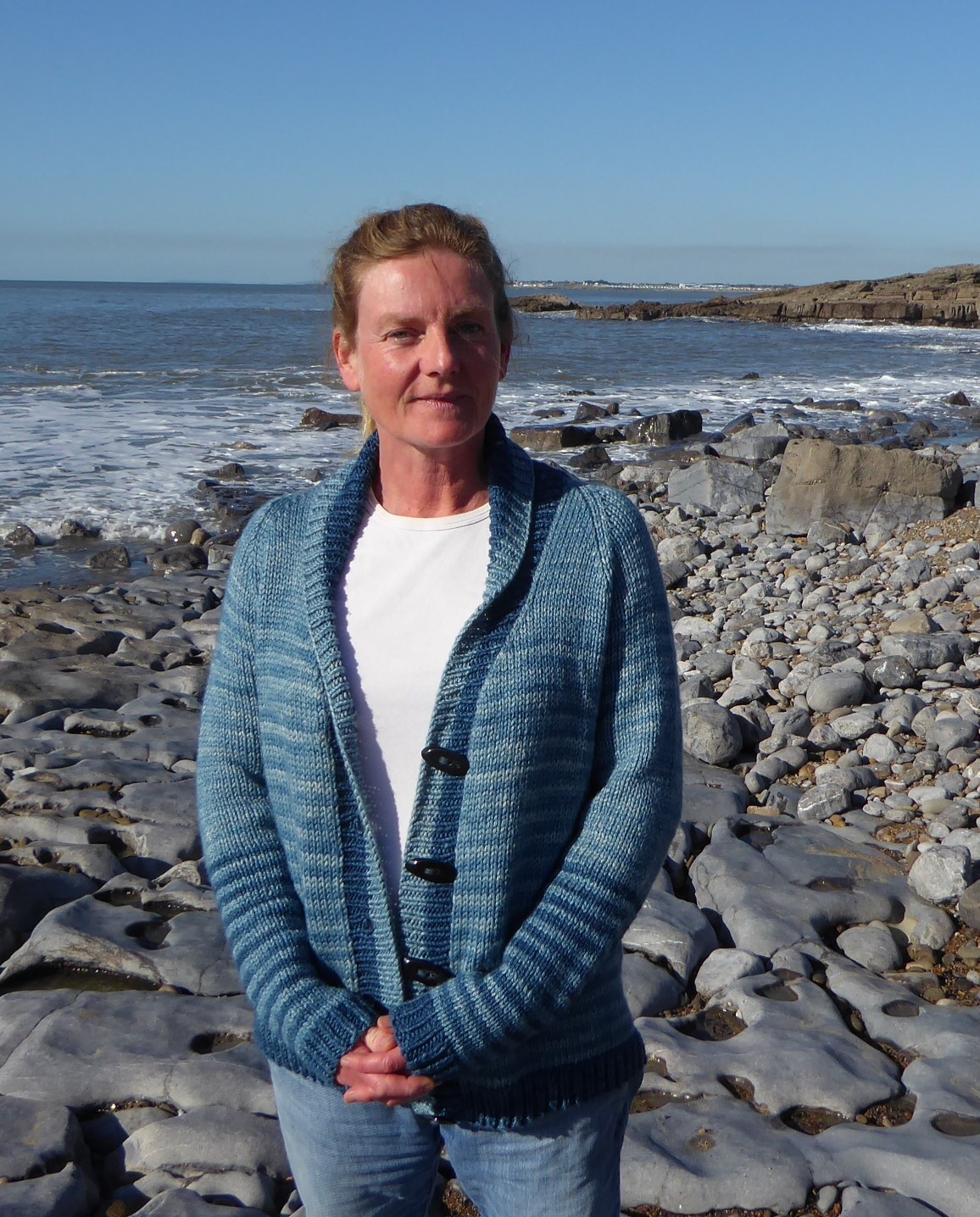
Shorelines Shawl Collar Cardigan Knitting Pattern

The Shorelines Shawl Collar Cardigan was designed to make the best of a perennial problem I have with plant dyed yarn. I can never dye a big enough batch in one go to knit a sweater or cardigan in a single, even colour. If all my yarn won't fit in one dye bath, I've found that how that however careful I am with weights of plant material, temperature of simmering and time in the pot, I can never match the exact colour I got last time. Even commercial producers using synthetic dyes can't repeat colours exactly. If you accidentally bought balls of yarn labelled as coming from different dye lots, this pattern might also work for you.
I started with a 1kg cone of 1000m chunky superwash merino and tussah silk blend yarn from World of Wool. Not cheap, but it takes up plant dyes well, the silk adding lustre and drape to a round bodied yarn, constructed in three plies. Divided into ten 100g skeins, I did my best to dye eight of them the same mid blue.

After repeated dips in two Japanese Indigo leaf vats, inevitably, all eight ended up slightly different colours. The two darkest skeins were intentionally dyed deeper for the trim. For the rest, rather than have blocks of knitting jumping from one shade to the next, I started with the two mid blues that were deepest and palest and knitted this cardigan in two row stripes of each. When a ball ran out, I carried on with the next nearest shade, ending up with a gradient of diminishing mid blue contrasts. The sleeves were knitted both at the same time, working with the same yarn from either end of a centre pull ball, to keep the colour changes matching. The sleeves were knitted flat then seamed, because trying to make jogless joins for stripes knitted in the round does my head in.


Shorelines Shawl Collar Cardigan Knitting Pattern


Materials

1000m chunky yarn - 200m contrast and 800m main colour (I had 90m left over)
4.5mm and 5.5mm needles - I used a long circular cord
4 stitch markers
Darning needle for sewing up and weaving in ends
5 buttons ~ 2cm diameter

Tension

After washing and smoothing flat to dry, 10cm squared = 14.5 stitches and 18 rows in stocking stitch. Using the yarn described, washing slightly increased the size of my swatch in both length and width, rather than shrinking it a bit - I suppose that's what 'superwash' yarn treatment does.

Size of Finished Item

One size 
108cm bust
(which fits me - 102cm chest/40" bust)
45cm sleeve
(I like the option to turn up tthe cuff)


Abbreviations
k = knit
k2tog = knit 2 stitches together
M1L = make 1 stitch angled left
M1R = make 1 stitch angled right
p = purl
PM = place marker
RS = right side
sl1, K1, psso = slip as if to purl, knit 1, pass slipped stitch over the stitch just knitted
SM slip marker
st = stitch
w&t = wrap yarn around needle and turn to work back in the other direction
WS = wrong side
yo = wrap yarn over needle before working next stitch

Method

BODY
Using 4.5mm needle and contrast colour, cast on 143 st
(WS) Row One   P1, *P1, K1* repeat from * to * to last two st, P2
(RS) Row Two    K1, *K1, P1* repeat from * to * to last two st, K2
Work this pattern for 9 rows to make ribbed edging, ending on a WS row.

Change to 5.5mm needle and main colour and work in stocking stitch until piece measures 40cm ending on a WS row. If you are making stripes, change colour every two rows, carrying yarn up alongside fabric edge. Leave st on needle with yarn still attached.

SLEEVES (Work two)
Using 4.5mm needle and contrast colour, cast on 33 st
(WS) Row One   P1, *P1, K1* repeat to last two st, P2
(RS) Row Two    K1, *K1, P1* repeat to last two st, K2
Work this pattern for 9 rows to make ribbed cuff, ending on a WS row.

Change to 5.5mm needle and main colour and work in stocking stitch for 8 rows, ending on a WS row. If you are making stripes, change colour every two rows, carrying yarn up alongside fabric edge.
Sleeve Increase Row   K1, M1L, K to last 2 st, M1R, K1
Work increase row on ninth row and every following tenth row until you have 49 stitches on the needle. Continue working stocking stitch until sleeve measures 45cm. Place first two stitches and last two stitches on safety pins, cut yarn allowing an end for weaving in and leave remaining 45 st on needle.


YOKE
Starting with a RS row on 5.5mm needles, knit 34st across body, place 4st on a safety pin and PM. Knit the 45st of one sleeve and PM. Knit 67st across body, place 4st on a safety pin and PM. Knit the 45st of the other sleeve and PM. Knit the remaining 34st of the body. (225st)
Purl back across all st, slipping markers.

Decrease Row for Neck and Yoke
K1, K2tog (neck decrease) *K to 3st before marker sl1, K1, psso, k1, SM, k2tog, K to 2 st before marker, K1, sl1, psso, SM, K1, K2tog* repeat from * to *, K to 3st before end, K1, sl1, psso (neck decrease), K1
Purl back across all st, slipping markers.
Repeat these two rows 9 times in total (135st)

Decrease Row for Yoke only
*K to 3st before marker sl1, K1, psso, k1, SM, k2tog, K to 2 st before marker, sl1, K1, psso, SM, K1, K2tog* repeat from * to *, K to end
Purl back across all st, slipping markers.
Repeat these two rows 12 times in total (39st)

Final decrease row
K1, Sl1, K1, psso, K1, remove marker, K2tog, K1, SM, K1, K2tog, K19, sl1, K1, psso, K1, remove marker, K1, sl1, K1, psso, remove marker, K1, K2tog, K1 (33st)
Purl back across all st, slipping 1 remaining marker and leave st on needle.

BUTTON BAND AND COLLAR

Using 4.5mm needle and the contrast colour yarn, with RS facing, starting at the bottom of the right front edge and working through the spaces between the first and second columns of stitches, pick up one st through the first four row interspaces, miss a space, continue picking up 4st from every 5 rows up the front, along the neck angle and up the straight edge of the neck, knit the first 5 live st from the needle, SM, K28, pick up 4st from every 5 rows of the straight edge of the neck, from the angled edge of the neck and from the left front edge.

First Row (WS) P1, *K1, P1* repeat from * to * until you reach the marker. Remove marker. If you just made a purl stitch, w&t now, if you just made a knit stitch, P1, w&t.
Second Row (RS) *K1, P1* repeat from * to * for 24 st, w&t

Short Rows for Collar
Working in the established rib pattern, when you reach the wrapped yarn, knit it together with the next stitch, P1, w&t. Repeat this for 28 short rows.

Next Row
Working in the established rib pattern, when you reach the wrapped yarn, knit it together with the next stitch, then continue P1, K1 rib to the end of the row at the bottom of the right front.

Next Row
Working in the established rib pattern, when you reach the wrapped yarn, knit it together with the next stitch, then continue P1, K1 rib to the end of the row at the bottom of the left front.

Work in rib for 3 full length rows

Buttonhole Row (RS) Work 3 st in rib, yo, sl1,K1, psso *work in rib for 12st, yo, sl1, K1, psso* repeat from * to * three more times to make 5 buttonholes, continue working in rib to end.

Change to Main Colour. Work 5 rows in rib, then cast off in rib, working more loosely around the edge of the collar to let the knitting fan out.

FINISHING
Graft together using Kitchener Stitch the four safety pinned stitches from the sleeve with the four stitches from the body at each underarm. Sew up the sleeve seams. Weave in all loose ends. Sew five buttons onto the left front edging in alignment with the buttonholes.

Notes to self - If I make another, think about making it sit on the hip rather than below it - maybe 10cm shorter in the body, and narrower around the hips with increases to reach this circumference above the waist, add in pockets like the ones in the Regeneration Jacket and make the shawl collar bigger by continuing with more short rows encompassing all the stitches of the neck. Would need 300g contrast and 700g main colour - hopefully ...


Friday, 26 January 2018

Japanese Indigo Plant Dye Results on Various Silk Yarns

Both these fingering weight 100% silk yarns were dyed with fresh Japanese Indigo leaves which I grew in my garden, then picked to make a vat, following a dye method specified on the Wild Colours website. I keep my Japanese Indigo plants well fed and watered, but the pale blue on these skeins reminds me there had been little sun to ripen the leaves in the early part of the summer. Their indigo content wasn't strong and even though I soaked all the silk  in water for a whole week before dipping it in the vat, the uptake of dye isn't perfectly even. 

My companion, Elinor Gotland, is something of a connoisseur where silk is concerned. 
'Might as well chuck out that stuff on the left, Beaut.'
'What, isn't it real silk?'
'Oh, it's silk alright, but it's just Tussah and not even good Tussah.'
'I could never chuck out silk -  as far as I'm concerned, pure silk still travels by camel, carried across the deserts from the mysterious Orient.'
'Silk is rarely pure and never simple. For a start, Tussah is made by worms that eat oak leaves and spin coarse brown cocoons that usually get dunked in bleach. After that, who knows what further horrors befell this drab collection of short, weak fibres.' Turning to the the other skein, Elinor sighed in satisfaction. 'Whereas this, my dear Fran, is Mulberry silk. From special worms fed only on mulberry leaves. They make cocoons of long, gossamer fine silk which is naturally white. On the long journey to you from the silkworms, these fibres have been carefully cleansed, tenderly unravelled and meticulously spun into glorious, gleaming yarn. Time to adjust your illusions, Beaut. Neither of these silks got here by camel train. Let's say, this Mulberry arrived by limousine and that Tussah waited 20 minutes in the rain for a bus.'
'Well, at least the Tussah took up the indigo dye better than the Mulberry. Mum bought it for a weaving project and I was planning to turn it a darker blue for her, once a bit more sunshine had built up the indigo in the plants for a better dye vat, only she got ill and died.'
'How awfully sad, such a mistaken purchase, the weaving would never have repaid her effort. A baby mouse could pull that Tussah apart. Never mind, you can make me something nice with the Mulberry.'


This single spun Tussah does indeed snap with a sharp tug, while you can pull on one strand of the plied Mulberry so hard it cuts into your hand and it still doesn't break. They say it takes a good friend to tell you an unwelcome truth, though as an ancient statesman once said, there is some self-interest behind every friendship. 


Putting both hanks of silk back in their bags and searching for another project, in my chest of stashed yarn, I found four 25g balls of Drops yarn, 77% brushed alpaca, 23% silk, - the label doesn't say what kind of silk. Originally, I bought two of the natural grey and two of the white. Early last summer, I dipped one of each into an indigo vat. The alpaca took up the indigo more strongly than the silk and I think the overdyed grey alpaca contrasts more dramatically with its silk core than the medium blue result on white alpaca does against the paler blue of the indigo uptake on the silk.


The brushed alpaca forms a cloud only loosely bound to the silk core of the yarn, which makes it very light and fluffy, though I generally expect silk to hang with great drape. I knitted it into a striped version of the Connections Cowl pattern. The original cowl, knitted in a silk/linen blend yarn, took 200m and weighed 100g, whereas this one needed a few extra pattern repeats to reach the same length and took 250m of yarn, but still only weighed 45g. Both yarns are categorised as worsted/double knitting at 9 wpi. I don't think the difference is simply grist, however it was prepared and spun, wool of the same grist as either would be unlikely to behave in the same way. Nature over nurture, a yarn's character must have much to do with its constituent fibres.


' Elinor, see how differently these cowls hang on me and my sister.'
'I see Pip can raise a smile with 100g of yarn around her neck. With less than half the amount of silk to carry, you look like a knackered camel. Come on, I'll put the kettle on. Reckon the old dromedary can still make it to the watering hole?'


Friday, 2 December 2016

Making Christmas Tree Angels with Tinsel Yarn Halos

"Ooo, I've never seen handspun, 
100% wool, eyelash yarn dyed gold with plants. Who'd have thought!" 
My companion has been rather a trial to live with this week. I pretended I hadn't heard her.
"Have you heard back from your agent about that audition yet?"
She remained apparently absorbed in marvelling over the tinsel yarn.
"Wonderful work. Such craft."
"Elinor, you know as well as I do that's just King Cole polyester."
"Oh, I don't take a dim view of a bit of sparkle, Beaut. You're the dreary eco-warrior round here." She let go of my three balls of shiny tinsel in order to push her specs up her nose and give me one of her looks. "I see the worm has not so much turned, as tied itself in a bow."


I bought this tinsel yarn with a view to adding halos to my usual wool fairy making process, in order to turn them into Christmas angels. 
Wrap most of the length of a long pipecleaner with white roving, just as you would for the arms. Now tie on the tinsel yarn near to one end and twist the pipecleaner to wrap a diagonal of tinsel around it, simply knotting it again when you get toward the other end. Bend the decorated, middle section into a circle, leaving a few centimetres of straight pipecleaner on either end.  Pass the wool roving meant for the head and body through this loop before you tie up the fairy's neck and it works a treat. Once the waist is also tied over the dress, the hidden straight part of the halo loop has been fixed in two places, making the whole thing firm, ready to be bent into its final position while you are adding hair.


I also made bigger, angel style wings, by folding two decent strips of white wool roving in half and tying them together about two thirds of the way up, then needlefelting them into a butterfly shape before knotting them around the fairy's waist.
I think these angels hang better with a thread suspending them from the waist, rather than the top of the head.


Next day, I spotted Elinor out in the frosty garden, deep in an angelic conflab. Tirion and Seren were bending low over her head. They were talking in Welsh and I couldn't make out what they were saying.


Elinor came back into the kitchen stamping her hooves against the cold.
"Did you hear any tidings of comfort and joy, then?"
"No, Beaut, I did not.  Fair play, Seren and Tirion are nice girls, but they tell me angels don't do wishes." She sighed as she unwound her scarf. "Never can find a fairy when you need one."
I reached for the tea bags.
"Put the kettle on, shall I?"